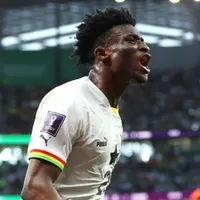

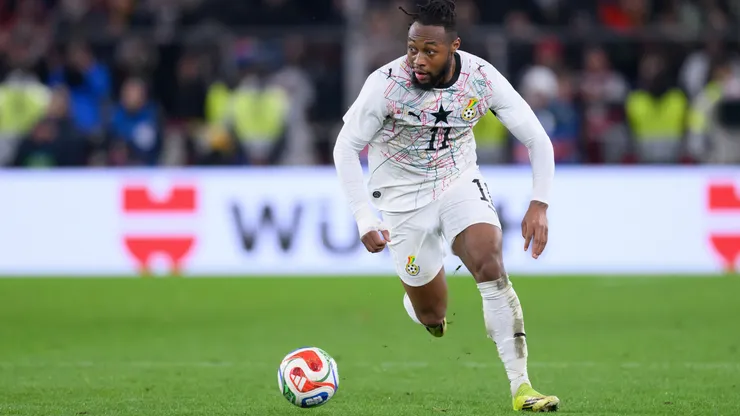
After a rebuilding phase and missing the 2025 AFCON, Ghana arrives in North America eager to reestablish itself as an African powerhouse.
The Black Stars secured their spot in the 2026 World Cup with a dominant qualifying campaign, leaning on a sturdy defense and opportunistic finishing. Now, they face a challenging path in the group stage.
Fans can expect a roster that blends experienced veterans with emerging stars, though the absence of key playmaker Mohammed Kudus looms large. This comprehensive preview breaks down Ghana’s tactical approach under newly appointed coach Carlos Queiroz, highlights standout forward Antoine Semenyo, and evaluates the team’s realistic chances of advancing to the knockout rounds this summer.
Team profile
| Coach | Carlos Queiroz |
| Captain | Jordan Ayew |
| Nickname | Black Stars |
| FIFA ranking | 74th |
| Confederation | CAF |
| Group | Group L |
| Best World Cup result | Quarterfinals (2010) |
| World Cup appearances | 4 |
| Last World Cup appearance | 2022 |
How Ghana play
With only a brief window to implement his system, expect Carlos Queiroz to prioritize defensive solidity over expansive soccer. Ghana will likely set up in a disciplined 4-3-3 or 4-1-4-1 formation, focusing heavily on maintaining a compact defensive block.
The Black Stars allowed just 0.6 goals per game during qualifying, a testament to their organized structure out of possession. Offensively, the team will rely on quick transitions and counter-attacks rather than dominating the ball. Wingers like Semenyo will be tasked with stretching the field and exploiting spaces left by opposing fullbacks.
However, the lack of creative midfield depth following Kudus’s injury is a glaring vulnerability. Opponents may attempt to force Ghana to dictate the tempo, testing their ability to break down set defenses. Ultimately, this pragmatic tactical approach could keep games close, giving the Black Stars a fighting chance to grind out results in a difficult group.
Carlos Queiroz: The coach behind Ghana
Appointed in April 2026 to replace Otto Addo, Carlos Queiroz brings decades of elite international experience to the Ghanaian sideline. The 73-year-old Portuguese manager is a seasoned veteran of the global stage, marking his fifth consecutive appearance at the international tournament.
Queiroz built his reputation as Sir Alex Ferguson’s trusted assistant at Manchester United before managing top programs like Real Madrid, Portugal, and Iran.
During his unprecedented tenure with Iran, he guided the nation to three straight global tournaments using a famously disciplined, defense-first philosophy.
Taking over just 70 days before the opening match, Queiroz faces an incredibly tight timeline to evaluate his roster and instill his trademark defensive organization. His unmatched tournament pedigree and pragmatic leadership could be exactly what the Black Stars need to navigate a demanding group-stage schedule.
Key player: Antoine Semenyo
Antoine Semenyo has rapidly evolved from a lower-league loanee to a Premier League standout and the primary attacking threat for the Black Stars. After a breakout stint with Bournemouth, the dynamic forward earned a high-profile transfer to Manchester City in early 2026, where he quickly secured an EFL Cup title.
Typically deployed on the right wing for the national team, Semenyo uses his pace and power to drive at defenders and cut inside for scoring opportunities. His ability to finish counter-attacks will be essential, especially since the squad is missing its primary creative midfielder.
Entering the summer in spectacular form, Semenyo carries the burden of producing goals against elite defenses. If he can replicate his club success on the international stage, Ghana possesses a legitimate weapon capable of punishing any opponent in the competition.
Ghana’s road to the 2026 World Cup
The Black Stars secured their ticket to North America by dominating CAF Group I, collecting 25 points with eight wins, one draw, and a single defeat. They finished six points clear of second-place Madagascar, netting a group-high 23 goals.
An early 1-0 away loss to Comoros served as a wake-up call, sparking a dominant run where Ghana won seven of their next eight matches. A crucial 2-1 road victory against Mali highlighted their resilience.
Captain Jordan Ayew led the charge with 11 goal involvements, while a sturdy defense conceded just six times across 10 fixtures. This commanding qualification campaign demonstrated a level of consistency that Ghana must now replicate against elite international competition.
Ghana’s 2026 World Cup group stage outlook
Ghana faces a daunting task in Group L, drawn alongside European heavyweights England and Croatia, as well as CONCACAF representative Panama. Navigating this top-heavy group will require flawless defensive execution and opportunistic scoring.
The opening matchup against Panama is undoubtedly the most favorable and arguably the most critical. Securing a decisive victory with a strong goal differential is essential for keeping advancement hopes alive. Conversely, facing an elite England squad presents the most difficult challenge, where avoiding a lopsided defeat will be a primary objective.
To reach the knockout rounds, the Black Stars likely need to claim three points against Panama while grinding out a result against an experienced Croatian side.
Readers looking to follow every match involving Ghana can also check our complete Ghana TV schedule for the latest broadcast and streaming information.
Ghana squad for 2026 World Cup
| Player (Position) | Club |
|---|---|
| Lawrence Ati-Zigi (GK) | St. Gallen |
| Joseph Anang (GK) | St Patrick’s Athletic |
| Benjamin Asare (GK) | Hearts of Oak |
| Alidu Seidu (DF) | Rennes |
| Abdul Mumin (DF) | Rayo Vallecano |
| Abdul Rahman Baba (DF) | PAOK |
| Jonas Adjetey (DF) | VfL Wolfsburg |
| Gideon Mensah (DF) | Auxerre |
| Jerome Opoku (DF) | İstanbul Başakşehir |
| Kojo Peprah Oppong (DF) | Nice |
| Derrick Luckassen (DF) | Pafos |
| Marvin Senaya (DF) | Auxerre |
| Caleb Yirenkyi (MF) | Nordsjælland |
| Thomas Partey (MF) | Villarreal |
| Kwasi Sibo (MF) | Oviedo |
| Augustine Boakye (MF) | Saint-Étienne |
| Elisha Owusu (MF) | Auxerre |
| Abdul Fatawu (FW) | Leicester City |
| Jordan Ayew (FW) | Leicester City |
| Brandon Thomas-Asante (FW) | Coventry City |
| Antoine Semenyo (FW) | Manchester City |
| Christopher Bonsu Baah (FW) | Al-Qadsiah |
| Prince Kwabena Adu (FW) | Viktoria Plzeň |
| Kamaldeen Sulemana (FW) | Atalanta |
| Iñaki Williams (FW) | Athletic Bilbao |
| Ernest Nuamah (FW) | Lyon |
Final word on Ghana
Entering the summer tournament, Ghana finds itself in a precarious position. The team boasts a proven, defensively sound manager and a lethal attacking threat in Antoine Semenyo, providing a clear blueprint for frustrating superior opponents.
However, the glaring absence of creative playmakers and a brutal group-stage draw present massive hurdles. Earning points against both England and Croatia is a monumental task for a squad still finding its rhythm under new leadership.
A realistic expectation for the Black Stars is a hard-fought group-stage exit, though a commanding opening win could spark an unlikely run to the knockout rounds.