



The FIFA World Cup has delivered unforgettable goals, dramatic upsets, and emotional celebrations throughout its history. It has also produced moments when discipline became the defining story, leaving national teams to battle with fewer players after costly dismissals. One particular edition stands above all the others for the number of red cards shown, making it one of the most controversial tournaments in soccer history.
From the earliest tournaments to the modern era of VAR, red cards have shaped countless World Cup matches. Some dismissals changed the course of title races, while others became iconic moments that are still discussed decades later. Before the introduction of colored cards, referees still had the authority to send players off, although they relied solely on verbal instructions and hand gestures.
The first recorded World Cup dismissal came in 1930, when Peru captain Placido Galindo was expelled during a group-stage match against Romania after protesting a referee’s decision and becoming involved in a heated confrontation.
To make disciplinary decisions easier to understand across different languages and cultures, FIFA introduced the yellow and red card system at the 1970 World Cup in Mexico. Interestingly, although the cards were available for the first time, no player received a red card during that tournament.
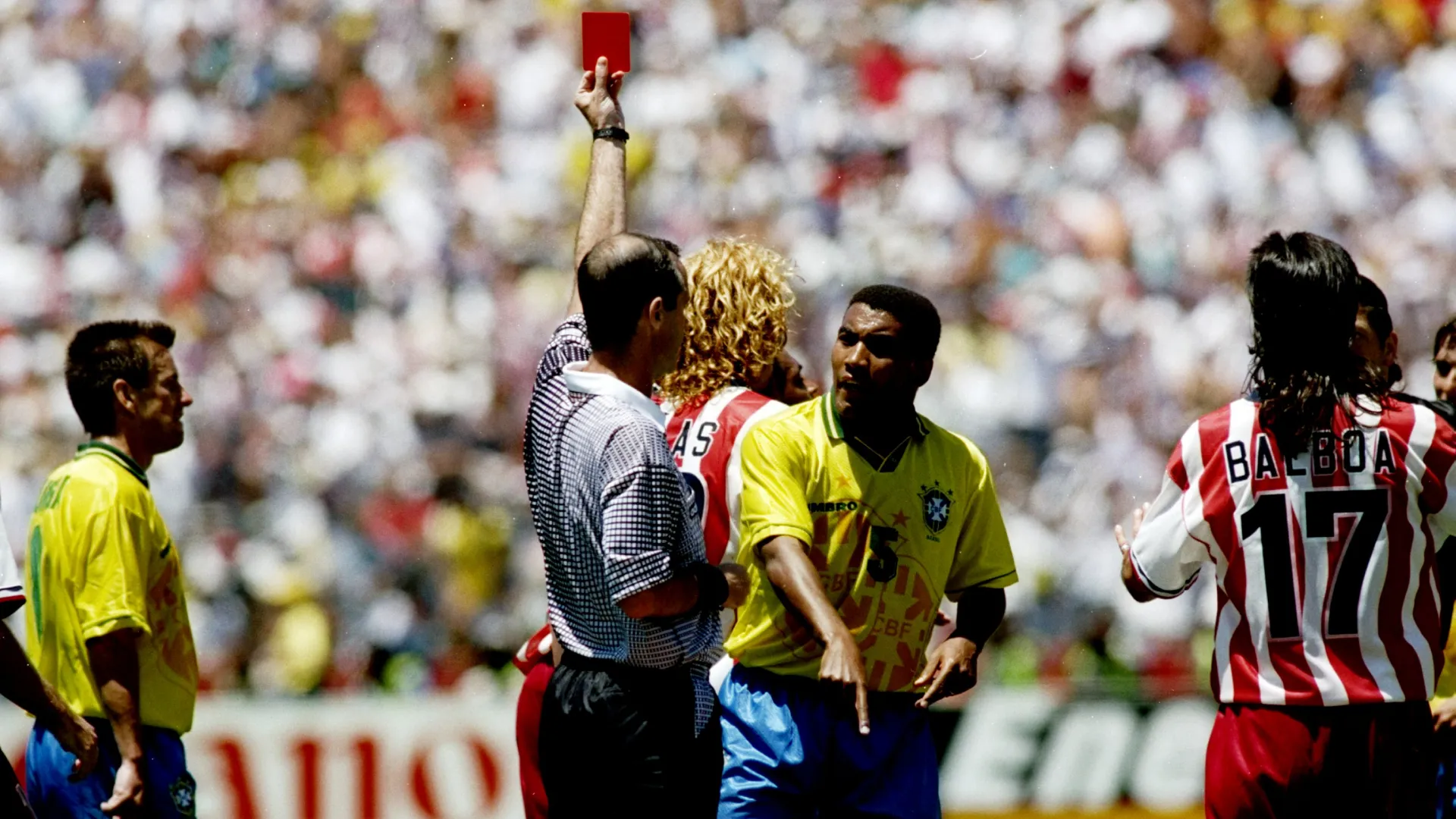
Mauro Silva of Brazil is shown the red card as he argues with the referee during the 1994 World Cup
The World Cup edition with the most red cards
As soccer became faster and more physical, disciplinary records steadily increased. The 2006 FIFA World Cup in Germany remains the tournament with the highest number of dismissals, producing an incredible 28 red cards across 64 matches.
That edition became famous for several explosive encounters, none more memorable than the infamous “Battle of Nuremberg” between Portugal and the Netherlands. Referee Valentin Ivanov issued 16 yellow cards and four red cards, making it the most ill-tempered match in World Cup history.
| World Cup | Host(s) | Matches | Red Cards | Red Cards per Match |
|---|---|---|---|---|
| 1930 | Uruguay | 18 | 1 | 0.056 |
| 1934 | Italy | 17 | 1 | 0.059 |
| 1938 | France | 18 | 4 | 0.222 |
| 1950 | Brazil | 22 | 0 | 0.000 |
| 1954 | Switzerland | 26 | 3 | 0.115 |
| 1958 | Sweden | 35 | 3 | 0.086 |
| 1962 | Chile | 32 | 3 | 0.094 |
| 1966 | England | 32 | 5 | 0.156 |
| 1970 | Mexico | 32 | 0 | 0.000 |
| 1974 | West Germany | 38 | 5 | 0.132 |
| 1978 | Argentina | 38 | 3 | 0.079 |
| 1982 | Spain | 52 | 5 | 0.096 |
| 1986 | Mexico | 52 | 8 | 0.154 |
| 1990 | Italy | 52 | 16 | 0.308 |
| 1994 | United States | 52 | 15 | 0.288 |
| 1998 | France | 64 | 22 | 0.344 |
| 2002 | South Korea / Japan | 64 | 17 | 0.266 |
| 2006 | Germany | 64 | 28 | 0.438 |
| 2010 | South Africa | 64 | 17 | 0.266 |
| 2014 | Brazil | 64 | 10 | 0.156 |
| 2018 | Russia | 64 | 4 | 0.063 |
| 2022 | Qatar | 64 | 4 | 0.063 |
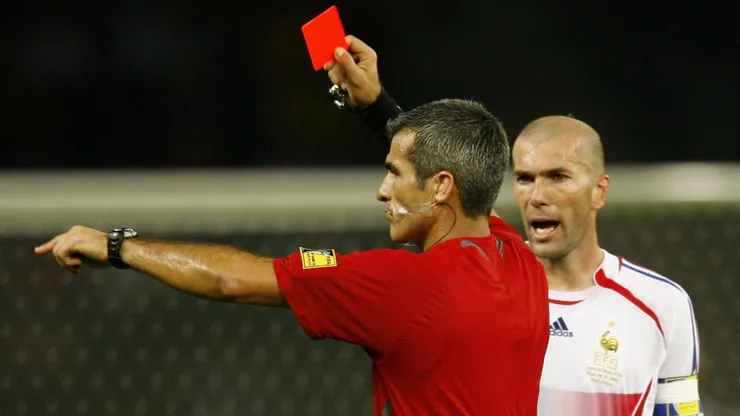
Another unforgettable moment arrived in the tournament’s final when France captain Zinedine Zidane was sent off for headbutting Italy defender Marco Materazzi during extra time. The dismissal marked one of the most shocking endings to an iconic international career and remains one of the defining moments in World Cup history.
Red card trends throughout World Cup history
Disciplinary records have fluctuated significantly across different tournaments. Early editions generally featured very few dismissals, although matches were often highly physical and referees lacked the visual card system that exists today.
Following the introduction of red cards in 1974, the numbers gradually increased before reaching their peak during the 1990s and 2000s. The 1990 tournament produced 16 dismissals, 1998 recorded 19, and 2006 established the all-time record with 28.
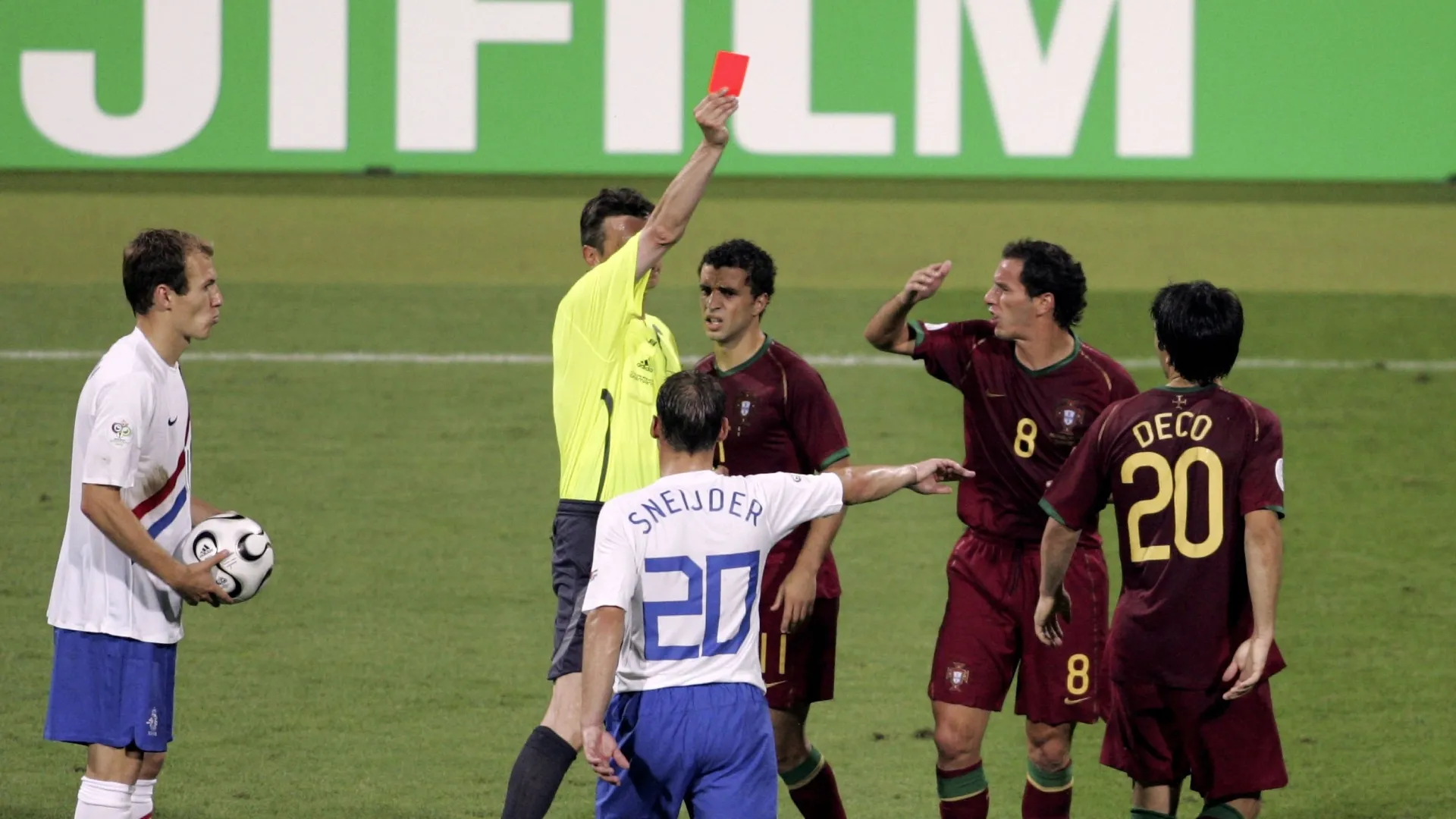
Deco #20 (R) of Portugal is shown the red card by Referee Valentin Ivanov of Russia.
In contrast, recent tournaments have seen a dramatic decline. Both the 2018 World Cup in Russia and the 2022 tournament in Qatar produced only four red cards each, making them the cleanest editions in the modern era.
Many observers attribute this decline to improvements in officiating, greater emphasis on player discipline, and the arrival of Video Assistant Referee (VAR), which has helped referees make more accurate decisions during critical incidents.
National teams with the most World Cup red cards
Some national teams have accumulated far more dismissals than others over the years. Brazil holds the unwanted record with 11 red cards in World Cup history, reflecting both its long participation record and several controversial moments.
Argentina follows with 10 red cards, while Uruguay has collected nine. Cameroon, Italy, Germany, the Netherlands, Nigeria, Portugal, and Russia also rank among the teams with the highest disciplinary totals across multiple tournaments.
| Rank | Team | Red Cards |
|---|---|---|
| 1. | Brazil | 11 |
| 2. | Argentina | 10 |
| 3. | Cameroon | 9 |
| 3. | Uruguay | 9 |
| 5. | The Netherlands | 8 |
| 5. | Italy | 8 |
| 5. | Germany | 8 |
| 8. | Portugal | 6 |
| 8. | Mexico | 6 |
| 8. | France | 6 |
| 11. | Hungary | 5 |
Individual records that still stand
Several individual dismissals have become permanent parts of World Cup folklore. Uruguay’s Jose Batista remains the fastest player ever sent off, receiving a red card just 56 seconds into a match against Scotland during the 1986 tournament.
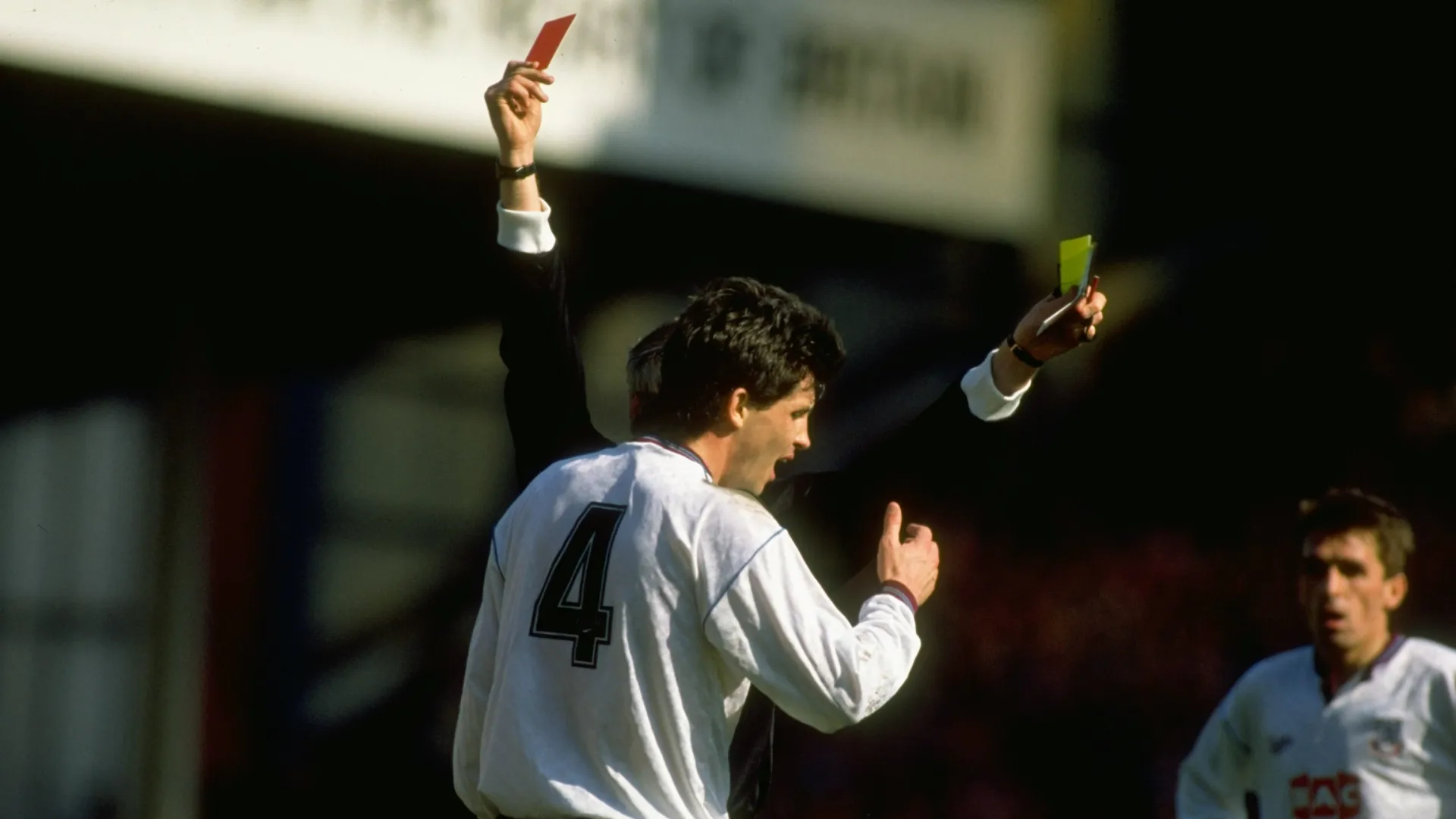
A player is sent off after being shown the red card by the referee
Only two players have ever been dismissed twice at the World Cup. Cameroon defender Rigobert Song received red cards in 1994 and 1998, while France legend Zinedine Zidane was sent off in both 1998 and the unforgettable 2006 final.
Goalkeepers have rarely suffered the same fate. Only Gianluca Pagliuca (Italy), Itumeleng Khune (South Africa), and Wayne Hennessey (Wales) have been dismissed during World Cup matches.