



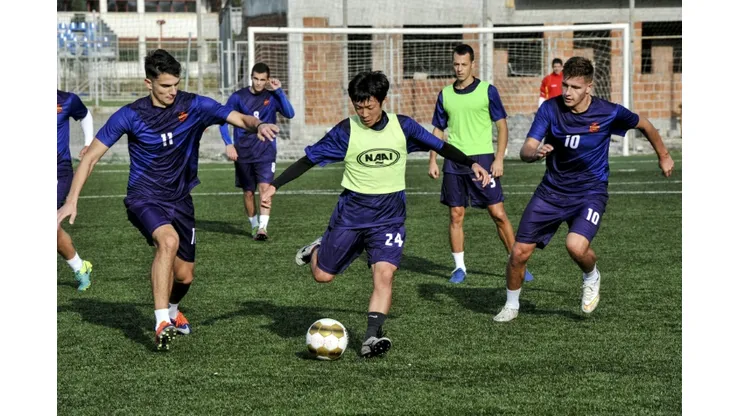
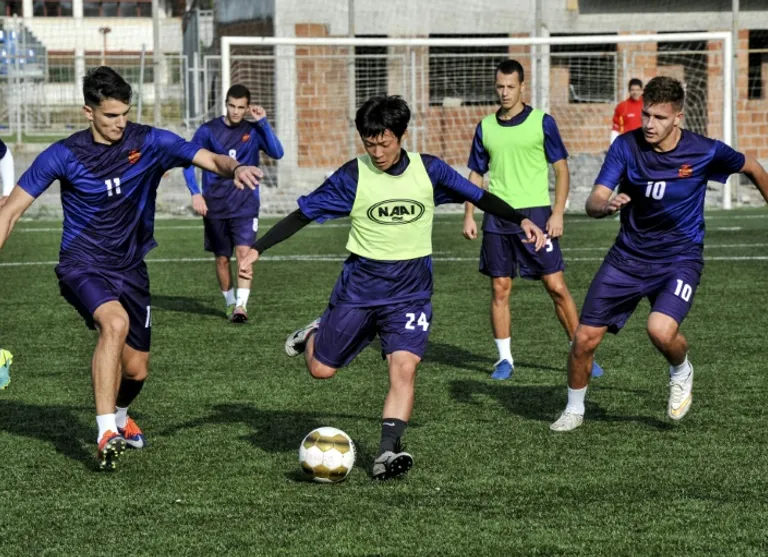
Podgorica (Montenegro) (AFP) – Montenegro is an unlikely magnet for Japanese footballers hoping to catch the eye of the major European leagues.
Some 40 Japanese are playing in 22 professional clubs in the Balkan country with a population of just over 600,000 amd around 140 have so far played in the former Yugoslav republic.
The club badge of the newly formed FK Adrija features the mouth of the picturesque Kotor bay at the bottom and Sukarajima volcano at the top — almost Japanese in design.
“I’ve always dreamed of playing in Europe,” said Kino Seiya, a 21-year-old student from Tokyo, who has joined FK Adrija.
“Looking at the information that I gathered about the best place for acclimatizing to European football, Montenegro appeared a good first step towards a professional career,” he said.
While economic and cultural exchanges between the two countries are fairly rare, links through football are booming.
The greatest player in Montenegro’s history, Dejan Savicevic, who heads the country’s football federation, won the then-European Cup with Red Star Belgrade in 1991 and then again with AC Milan three years later.
The tradition of Yugoslav coaches working abroad led many of them to Japan, such as the well-travelled Vahid Halilhodzic who has guided Japan to qualification for the 2018 World Cup.
Others are Ivica Osim — who in 2006 and 2007 coached Japan — and Dragan ‘Piksi’ Stojkovic, a former player and then coach of Nagoya Grampus Eight.
However, it is a lesser-known figure who since 2013 has been responsible for the Japanese enthusiasm for the mountainous nation bordering the Adriatic, whose clubs are struggling with decrepit infrastructure — a far cry from Japan.
After playing in the lower divisions in Japan and training young players, Pedja Stevovic brought the Japanese to his homeland.
This year he founded FK Adrija in the capital Podgorica and the club aspires to compete in Montenegro’s higher divisions.
“Montenegrins are characterised by individual qualities, while discipline and responsibility are the strengths of the Japanese,” said 46-year-old Stevovic.
“Their interaction could make us progress enormously, both collectively and individually.”
– A springboard ? –
“Japan ‘produces’ between 7,000 and 10,000 players a year. They can’t all find a place in the competitions,” he said.
“The Japanese first division has only 1,500 players. Those who do not make it either give up football or try their luck abroad.”
In Montenegro, these players, who often come from the university system, will earn between 8,000 and 17,000 euros ($9,400 and $20,000) annually.
Stevovic is the club’s president and there several Japanese on its management board as well as three players on the pitch and one Japanese assistant coach.
Hayashi Yuske, a 25-year-old nutritionist by trade who has been playing for the last two years in Montenegro, said he wanted to learn “a form of sports egoism” — in Japan, he explained, “everything is subordinated to the collective”.
“What is striking here is this hunger for individual success even at the expense of the collective,” he said. “In Japan it’s unimaginable.”
Yuske dreams of attracting the attention of an Australian club.
The learning process goes both ways.
“The Japanese never give up. Discipline, responsibility and commitment is what I want to learn from them,” his 19-year-old Montenegrin teammate Radoje Vlalovic said.
But is Montenegro really a springboard?
“They come here to toughen up,” Stevovic said, and for some it is working.
After spending the 2013 season with Mladost Podgorica, Taku Ishihara made his way to the German second division.
After two seasons with Rudar Pljeljva, Kohei Kato now plays for Bulgaria’s Stara Zagora, after a stay in Poland.
According to Stevovic, there is a “natural route” to countries “of the former Yugoslavia, then to Western Europe”.
Another effect is that “their price increases in Asia and they return there.”