

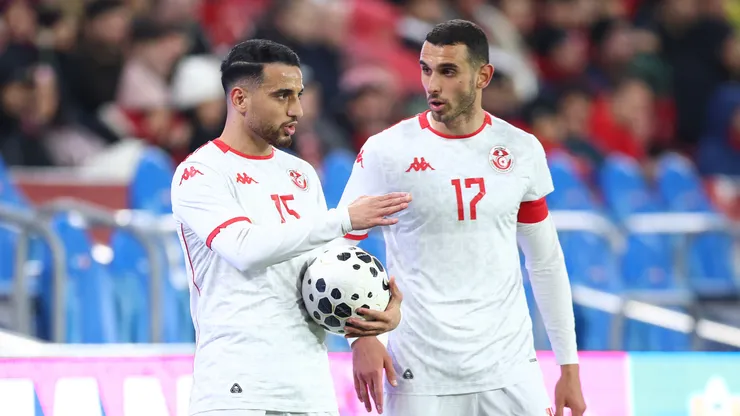
Tunisia arrives at the 2026 tournament aiming to break a long-standing barrier.
The North African nation has competed in six previous global tournaments but has never advanced past the group stage. Heading to North America, the Eagles of Carthage bring an elite defensive record from their qualification campaign.
They navigated their regional group without conceding a single goal. While their defensive structure is formidable, questions remain about their attacking output against higher-level opposition.
This preview explores how their sturdy tactical setup, the leadership of coach Sabri Lamouchi, and a challenging group-stage draw will shape their summer campaign.
Team profile
| Coach | Sabri Lamouchi |
| Captain | Ellyes Skhiri |
| Nickname | Eagles of Carthage |
| FIFA ranking | 45th |
| Confederation | CAF |
| Group | Group F |
| Best World Cup result | Group stage |
| World Cup appearances | 6 |
| Last World Cup appearance | 2022 |
How Tunisia play
Tunisia prioritizes defensive stability and structural discipline over expansive attacking soccer.
Under Sabri Lamouchi, the team operates primarily out of a 4-3-3, 4-2-3-1, or 4-4-1-1 formation. They rely heavily on a compact low block to frustrate opponents.
Out of possession, the Eagles of Carthage maintain a rigid shape. Midfielders like Rani Khedira and Aïssa Laïdouni provide relentless energy to disrupt passing lanes. This conservative approach limits clear-cut chances for the opposition, making Tunisia incredibly difficult to break down.
However, their reliance on defensive solidity often leaves them isolated in the attacking third.
The team depends on quick counterattacks and individual moments from younger creative players like Ismaël Gharbi and Elias Achouri. Because these attackers lack prolific goal-scoring records, creating sustainable offense remains a significant hurdle.
Sabri Lamouchi: The coach behind Tunisia
Lamouchi took charge of the Tunisian national team in January 2026, bringing extensive international experience to the role.
The former French international enjoyed a stellar playing career with clubs like Auxerre, Monaco, and Inter Milan. Transitioning to the touchline, Lamouchi has managed teams ranging from Nottingham Forest to Rennes.
Crucially, he already possesses global tournament experience, having led the Ivory Coast during the 2014 competition in Brazil. This background gives him a clear understanding of the unique pressures involved in a summer tournament.
Lamouchi demands tactical discipline and rapid transitions from his squads. His pragmatic leadership and ability to organize a resolute defense will dictate how Tunisia handles the elite opposition waiting in North America.
Key player: Ellyes Skhiri
Ellyes Skhiri serves as the heartbeat of the Tunisian midfield. The 31-year-old Eintracht Frankfurt veteran provides essential defensive coverage and leadership as the national team captain. Skhiri operates primarily as a defensive or box-to-box midfielder.
He excels at reading the game, registering 25 interceptions in the Bundesliga last season. His elite stamina allows him to cover massive distances, compensating for a relative lack of straight-line speed.
By anchoring the midfield, he grants the team’s creative players the freedom to take calculated attacking risks.
Tunisia’s road to the 2026 World Cup
Tunisia delivered a masterclass in defensive organization during their qualification campaign. They topped CAF Group H with an unbeaten record of nine wins and one draw. The Eagles of Carthage collected 28 points and achieved a staggering feat by not conceding a single goal across ten matches.
They scored 22 times, with Mohamed Ali Ben Romdhane leading the charge with four goals. His 90th-minute winner away against Equatorial Guinea served as the defining moment of the cycle, breaking their closest rival’s resolve.
This dominant qualifying run highlighted their defensive perfection, though replicating that impenetrable form against global powerhouses will be their ultimate test.
Tunisia’s 2026 World Cup group stage outlook
Tunisia faces a daunting challenge in Group F alongside the Netherlands, Japan, and Sweden. This quartet represents one of the most difficult groups in the entire competition.
The Netherlands enters as the clear favorite, presenting the most challenging matchup for the North African side. Japan and Sweden both possess dynamic, high-scoring attacking units capable of dismantling deep defensive blocks. To survive, Tunisia must rely on their trademark defensive resilience to frustrate these technically superior opponents.
Readers looking to follow every match involving Tunisia can also check our complete Tunisia TV schedule for the latest broadcast and streaming information.
Tunisia squad for 2026 World Cup
| Player (Position) | Club |
|---|---|
| Sabri Ben Hessen (GK) | Étoile du Sahel |
| Aymen Dahmen (GK) | CS Sfaxien |
| Mouhib Chamakh (GK) | Club Africain |
| Dylan Bronn (DF) | Servette |
| Ali Abdi (DF) | Nice |
| Yan Valery (DF) | Young Boys |
| Mohamed Amine Ben Hamida (DF) | Espérance de Tunis |
| Omar Rekik (DF) | Maribor |
| Adem Arous (DF) | Kasımpaşa |
| Raed Chikhaoui (DF) | US Monastir |
| Moutaz Neffati (DF) | IFK Norrköping |
| Montassar Talbi (DF) | Lorient |
| Hannibal Mejbri (MF) | Burnley |
| Rani Khedira (MF) | Union Berlin |
| Hadj Mahmoud (MF) | Lugano |
| Ellyes Skhiri (MF) | Eintracht Frankfurt |
| Anis Ben Slimane (MF) | Norwich City |
| Ismaël Gharbi (MF) | FC Augsburg |
| Khalil Ayari (FW) | Paris Saint-Germain |
| Elias Saad (FW) | Hannover 96 |
| Hazem Mastouri (FW) | Dynamo Makhachkala |
| Mortadha Ben Ouanes (FW) | Kasımpaşa |
| Elias Achouri (FW) | Copenhagen |
| Sebastian Tounekti (FW) | Celtic |
| Firas Chaouat (FW) | Club Africain |
| Rayan Elloumi (FW) | Vancouver Whitecaps FC |
Final word on Tunisia
Tunisia enters the 2026 World Cup as a massive underdog in a highly competitive group. Their flawless defensive record during qualification provides a sturdy foundation, ensuring they will not be easily overrun. However, their distinct lack of attacking firepower remains a critical vulnerability.
Surviving Group F demands more than just defensive resilience; it requires scoring goals against elite competition. A realistic expectation sees the Eagles of Carthage battling hard but ultimately struggling to secure the victories needed to advance past the opening stage.