


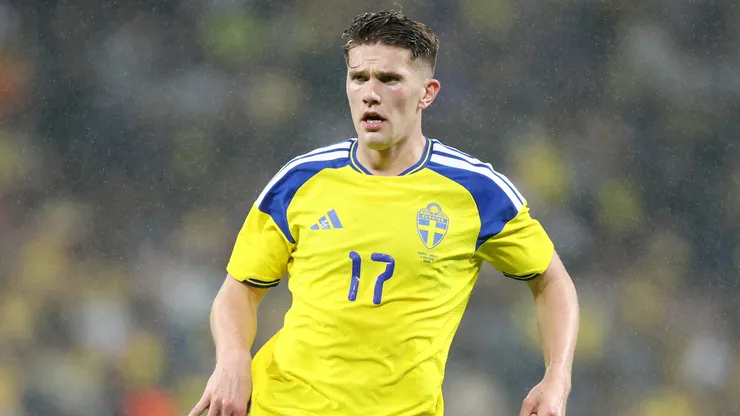
Sweden enters the 2026 tournament as an intriguing unknown following a dramatic turnaround. As one of the most unpredictable FIFA World Cup 2026 teams, the Blågult (Blue and Yellow) found their footing at the exact right moment to secure a spot in North America.
Currently sitting 38th in the global rankings, the squad boasts an elite attacking duo in Viktor Gyökeres and Alexander Isak. Their lethal combination up top gives the team a chance to trouble the world’s best defenses this summer.
This World Cup 2026 team preview breaks down everything you need to know about the Swedish national team. We will provide a complete Sweden tactical analysis, dive into the roster depth, and evaluate their challenging group-stage outlook.
Team profile
| Coach | Graham Potter |
| Captain | Victor Lindelöf |
| Nickname | Blågult (The Blue and Yellow) |
| FIFA ranking | 38th |
| Confederation | UEFA |
| Group | Group F |
| Best World Cup result | Runners-up (1958) |
| World Cup appearances | 12 |
| Last World Cup appearance | 2018 |
How Sweden play
Under Graham Potter, the preferred Sweden formation attempts to transition toward a more possession-based, progressive style of soccer. The team generally looks to build out from the back and utilize flexible positioning to break down opposing defenses.
However, their recent playoff performances showed a reliance on quick transitions rather than sustained possession. Against Ukraine, they held the ball for just 32% of the match, relying heavily on counter-attacks to exploit high defensive lines.
Their primary tactical strength lies in feeding their center forwards. By playing direct passes into the channels, they allow Sweden key players like Anthony Elanga and Gyökeres to stretch the field and create space for trailing midfielders.
Defensively, the squad has shown vulnerabilities, conceding an average of 2.0 goals per 90 minutes during the initial group phase of qualifying. They must tighten their defensive shape and improve their pressing structure to survive against elite international competition.
Graham Potter: The coach behind Sweden
Graham Potter took charge of the national team late in the qualification cycle, inheriting a squad in complete disarray. The English Sweden coach arrived with a reputation for tactical flexibility and progressive soccer.
Potter is no stranger to Scandinavian soccer. He previously guided Östersund from the fourth tier of the Swedish pyramid all the way to European competition, establishing a deep connection with the country’s soccer culture.
Known for his calm demeanor and ability to maximize squad potential, he quickly stabilized the locker room and navigated the high-pressure playoff matches. His tactical acumen and proven leadership will be the deciding factors in whether this roster can overachieve during the summer tournament.
Key player: Viktor Gyökeres
Viktor Gyökeres enters the 2026 tournament as the undisputed focal point of the Swedish attack. The Arsenal striker has translated his prolific club form to the international stage, scoring 19 goals in 32 appearances for his country.
His incredible hat-trick against Ukraine in the playoff semifinal and an 88th-minute game-winner against Poland solidified his status as the squad’s most crucial asset. Physically imposing and deceptively fast, Gyökeres excels at running the channels and dragging center-backs out of position.
This movement perfectly complements the national team’s transition-heavy tactical approach, creating massive pockets of space for his teammates. He thrives when facing high defensive lines, using his elite finishing ability to punish mistakes.
Sweden’s road to the 2026 World Cup
Sweden’s path to the North American tournament was nothing short of miraculous. The team finished dead last in their initial UEFA qualifying group, failing to win a single game while scoring just four goals and suffering four defeats.
However, their previous success in the UEFA Nations League granted them a crucial lifeline into the playoff round. Under a new manager, they completely flipped the script in March 2026.
A commanding 3-1 victory over Ukraine set up a decisive playoff final against Poland. A late 3-2 victory secured their ticket to the global stage.
Sweden’s 2026 World Cup group stage outlook
The Blågult face a remarkably difficult path through Group F, drawn alongside the Netherlands, Japan, and Tunisia. This balanced group leaves very little room for error during the opening stage.
The Netherlands represent the most challenging matchup and are favored to claim the top spot. The pivotal fixture will likely be the clash against Japan, a squad with a proven track record of advancing past the group stage.
Tunisia is the most favorable matchup on paper, but they remain difficult to break down defensively. Sweden must secure three points in that opening fixture to build momentum.
Readers looking to follow every match involving Sweden can also check our complete Sweden TV schedule for the latest broadcast and streaming information.
Advancing as one of the best third-place teams might be their most likely route to the knockout rounds.
Sweden 2026 World Cup squad
| Player (Position) | Club |
|---|---|
| Viktor Johansson (GK) | Stoke City |
| Jacob Widell Zetterström (GK) | Derby County |
| Kristoffer Nordfeldt (GK) | AIK |
| Gustaf Lagerbielke (DF) | Braga |
| Victor Lindelöf (DF) | Aston Villa |
| Carl Starfelt (DF) | Celta Vigo |
| Gabriel Gudmundsson (DF) | Leeds United |
| Isak Hien (DF) | Atalanta |
| Hjalmar Ekdal (DF) | Burnley |
| Daniel Svensson (DF) | Borussia Dortmund |
| Herman Johansson (DF) | FC Dallas |
| Eric Smith (DF) | St. Pauli |
| Elliot Stroud (DF) | Mjällby AIF |
| Lucas Bergvall (MF) | Tottenham Hotspur |
| Besfort Zeneli (MF) | Union Saint-Gilloise |
| Jesper Karlström (MF) | Udinese |
| Yasin Ayari (MF) | Brighton & Hove Albion |
| Mattias Svanberg (MF) | VfL Wolfsburg |
| Ken Sema (FW) | Pafos |
| Gustaf Nilsson (FW) | Club Brugge |
| Benjamin Nygren (FW) | Celtic |
| Anthony Elanga (FW) | Newcastle United |
| Viktor Gyökeres (FW) | Arsenal |
| Alexander Isak (FW) | Liverpool |
| Alexander Bernhardsson (FW) | Holstein Kiel |
| Taha Ali (FW) | Malmö FF |
Final word on Sweden
Heading into the 2026 tournament, Sweden is a volatile team capable of both brilliant attacking displays and frustrating defensive lapses.
Their world-class strike partnership provides enough firepower to outscore almost any opponent, setting them apart from many international soccer teams 2026 will feature. However, their inability to control possession and dictate the tempo of matches remains a significant hurdle against top-tier competition.
A realistic expectation for this squad is successfully navigating the group stage. Reaching the Round of 32 would represent a solid achievement for a program still rebuilding its identity on the global stage.