


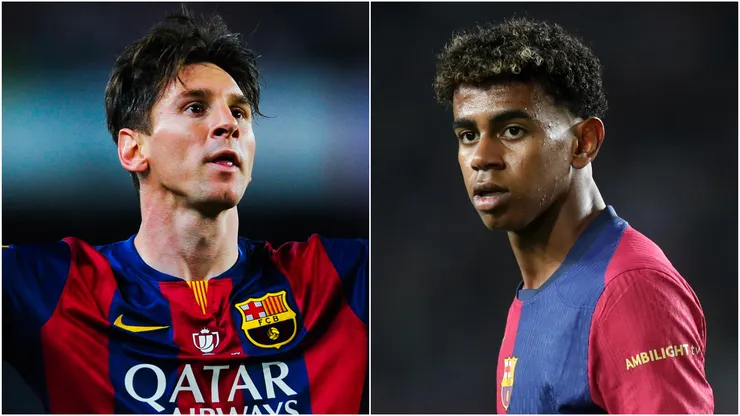
Barcelona has lived many lives, but few clubs in world soccer have been so deeply shaped by individuals as the Catalan giant. There was a time when the club moved to the rhythm of one man, when every decision—tactical, emotional, even institutional—flowed through him. Today, another prodigious talent has emerged, not as a savior, but as a reflection of what Barcelona is trying to become again. Lionel Messi meant everything to one era of the club, while Lamine Yamal is beginning to define a very different chapter—one rooted in reconstruction rather than supremacy.
For almost two decades, Messi was Barcelona’s gravitational center. From the mid-2000s until his departure in 2021, the club was built around his genius. On the pitch, systems bent to his movements. Teammates existed to amplify his strengths. Matches were planned not around opponents, but around what Messi could unlock.
The Blaugrana’s greatest achievements—Champions League triumphs, domestic dominance, and the global elevation of tiki-taka—were inseparable from him. He was not merely part of the system; he was the system. His goals and assists did not just decide matches; they validated a philosophy built on La Masia, positional play, and technical superiority. Off the pitch, the Argentine became Barca’s identity. The club’s global image fused with his: humility, loyalty, and artistry. For millions of supporters, Barcelona was Messi, and Messi was Barcelona.
That fusion, however, came with a hidden cost. As the years passed, the Catalans stopped imagining life beyond him, and sporting planning narrowed. However, financial risk increased, and emotional dependence deepened. When Messi finally left, it was not just a transfer—it was an institutional rupture that exposed how fragile the foundations had become without him.
Yamal: Hope in time of reconstruction
Lamine Yamal has arrived at a team that could not be more different. This is a club emerging from financial crisis, sporting instability, and an identity reckoning. Crucially, He is not being asked to carry the club—and that may be the most important difference of all. What the Spanish teenager represents is not dominance, but possibility.
At just 18, his rise has restored belief in La Masia at a moment when the club desperately needed reassurance. Where Messi once embodied inevitability, Yamal embodies renewal. His presence tells supporters that Barcelona can still produce elite talent organically, even amid crisis.
Tactically, he is a weapon rather than a crutch. He brings unpredictability, verticality, and joy, but the team does not orbit around him. That restraint is deliberate. Barcelona understands now the danger of building an entire institution around a single figure. Emotionally, Yamal reconnects fans with something they feared they had lost: fun. His fearlessness, creativity, and willingness to take responsibility evoke echoes of Messi’s early years—without the suffocating burden of expectation.
125 games apart, two very different journeys
Only after Yamal reached a milestone did the numbers invite comparison. This week against Guadalajara, he made his 125th appearance for Barcelona, an astonishing figure for a player still in his teens. At the same stage, Messi was already established—but older. Messi was 21 when he reached 125 games. Yamal is just 18, and the raw figures are striking:
| Player | Games | Goals | Assists | Goal Contributions |
|---|---|---|---|---|
| Lamine Yamal | 125 (aged 18) | 33 | 45 | 78 |
| Lionel Messi | 125 (aged 21) | 54 | 27 | 81 |
Messi was more prolific in front of the goal. Yamal, by contrast, has emerged as a creator at an extraordinary rate. Yamal already has 18 more assists than Messi did at the same stage, even though Messi would go on to become the greatest assister in soccer history.