




FIFA’s latest financial data has quietly confirmed what many in world soccer have sensed for months: the center of gravity is shifting again. With Cristiano Ronaldo already embedded in the project and elite names such as Ousmane Dembele, Vinicius Junior, Mohamed Salah, and Robert Lewandowski circling the conversation, the governing body has revealed which Asian clubs dominated global spending in 2025 — just ahead of what is being described as another Saudi revolution.
At first glance, the figures speak of scale rather than direction. But underneath them lies a deeper strategy, one that suggests Saudi soccer is preparing to evolve once more — not merely by spending, but by redefining who it spends on and why. According to FIFA’s Global Transfer Report 2025, international soccer experienced an unprecedented surge in activity. A total of 24,558 international transfers were completed in men’s soccer alone, representing a 7% increase from 2024 and the highest annual figure ever recorded.
Across men’s, women’s, and amateur soccer combined, FIFA registered 86,158 international transfers, another all-time high. Total spending on transfer fees climbed to $13.08 billion, shattering the previous record. England remained the world’s dominant spender, with clubs collectively investing $3.82 billion, while Brazil recorded the highest volume of player movement. Yet the most telling story was not in Europe or South America — it was in Asia.
Saudi spending never truly slowed
Although the Saudi Pro League’s explosive 2023 wave initially appeared to cool, 2025 proved that the slowdown was strategic rather than financial. Clubs continued to commit vast sums while reshaping their recruitment philosophy.
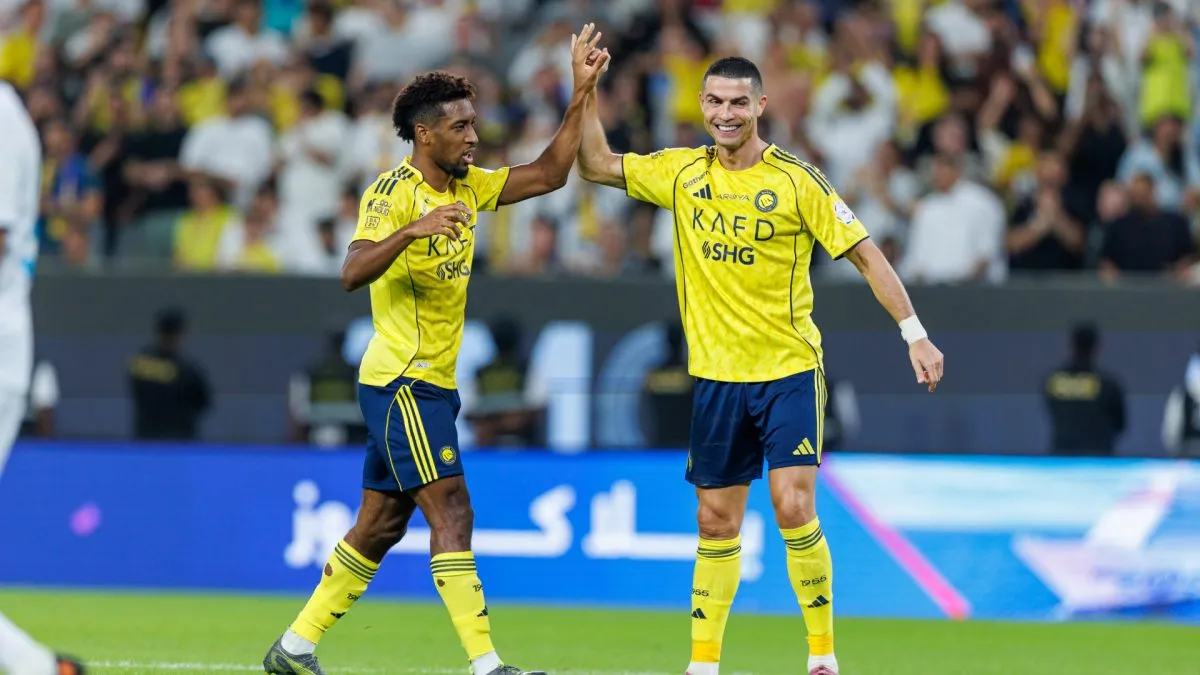
Kingsley Coman celebrating with Cristiano Ronaldo
Al-Hilal entered a new era under Simone Inzaghi, spending heavily on Darwin Nunez ($80 million) and Theo Hernandez ($27 million). Al-Qadsiah surpassed $110 million in outlay, headlined by Mateo Retegui’s $74 million move. Government-backed NEOM crossed the $115 million mark, combining emerging talent with experienced stars such as Alexandre Lacazette.
Meanwhile, Al-Nassr reinforced its status as a global magnet by signing Joao Felix for $54 million and Kingsley Coman for $38 million, while Cristiano Ronaldo extended his contract, remaining the league’s defining figure both commercially and competitively. Midway through its report, FIFA confirmed the highest-spending Asian clubs for 2025, though it did not disclose exact totals.
| Rank | Club | Country |
|---|---|---|
| 1. | Al-Nassr | Saudi Arabia |
| 2. | Al-Hilal | Saudi Arabia |
| 3. | Al-Ahli | Saudi Arabia |
| 4. | Al-Qadsiah | Saudi Arabia |
| 5. | NEOM | Saudi Arabia |
| 6. | Al-Ittihad | Saudi Arabia |
| 7. | Al-Duhail | Qatar |
| 8. | Al-Sadd | Qatar |
| 9. | Al-Wasl | United Arab Emirates |
| 10. | Al-Jazira | United Arab Emirates |
The ranking places Cristiano Ronaldo’s Al-Nassr at the very top, confirming the club as the financial benchmark not just in Saudi Arabia, but across Asia.
New target profile emerges
What makes this moment different is not simply the money — it is the shift in ambition. Saudi decision-makers are no longer focused solely on iconic veterans. Instead, the attention has turned toward elite players still operating at the very peak of European soccer.

Ousmane Dembele of Paris Saint-Germain looks on
According to Sky Sports, Saudi officials are “laying the groundwork” for a future move for Ballon d’Or winner Ousmane Dembele, whose PSG contract situation remains unresolved. Similarly, The Telegraph and journalist Ben Jacobs report that Mohamed Salah and Vinicius Junior remain priority targets, while Robert Lewandowski has emerged as part of a broader shortlist aimed at redefining the league’s global image.