


Cristiano Ronaldo’s retirement from international soccer brings an extraordinary chapter in Portuguese soccer to a close, while inevitably reviving comparisons with another national icon, Eusebio. The two legends dominated different generations, but their achievements have shaped Portugal’s identity on the global stage in ways few players could imagine.
At 41, Ronaldo has decided to end his 23-year international career, leaving behind records, trophies and a legacy that will be difficult to surpass. His announcement came on Thursday, November 5, following a turbulent period involving Portugal head coach Jorge Jesus.
Ronaldo confirmed his retirement through a five-minute video message shared on social media, reflecting on the privilege of representing his country since making his senior debut in August 2003. “To the Portuguese people, the day has come for me to hand back the number seven shirt of our national team. I never felt it belonged to me alone, but for 23 years I had the privilege and the responsibility of wearing it, defending it and carrying it with me into stadiums all around the world,” he said.
The Portuguese forward also acknowledged that the decision was difficult, explaining that his international journey had changed his life. He leaves Portugal with 234 appearances and 146 goals, holding the men’s world records for both international caps and goals.
His departure follows a disagreement with Jesus after the coach left him on the bench against Norway, despite reportedly discussing a potential 30-minute appearance beforehand. Ronaldo subsequently left the national team camp, bringing renewed attention to his relationship with the coach and his international future.

see also
Lionel Messi’s Argentina retirement: How his stats compare to Diego Maradona
Trophy collection that changed Portugal’s history
Ronaldo’s influence extended far beyond individual records. He captained Portugal to its first European Championship title at Euro 2016, before adding UEFA Nations League trophies in 2019 and 2025.
His international career also included appearances at six European Championships and six World Cups. He became the European Championship’s all-time leading scorer with 14 goals and Portugal’s leading World Cup scorer with 11.
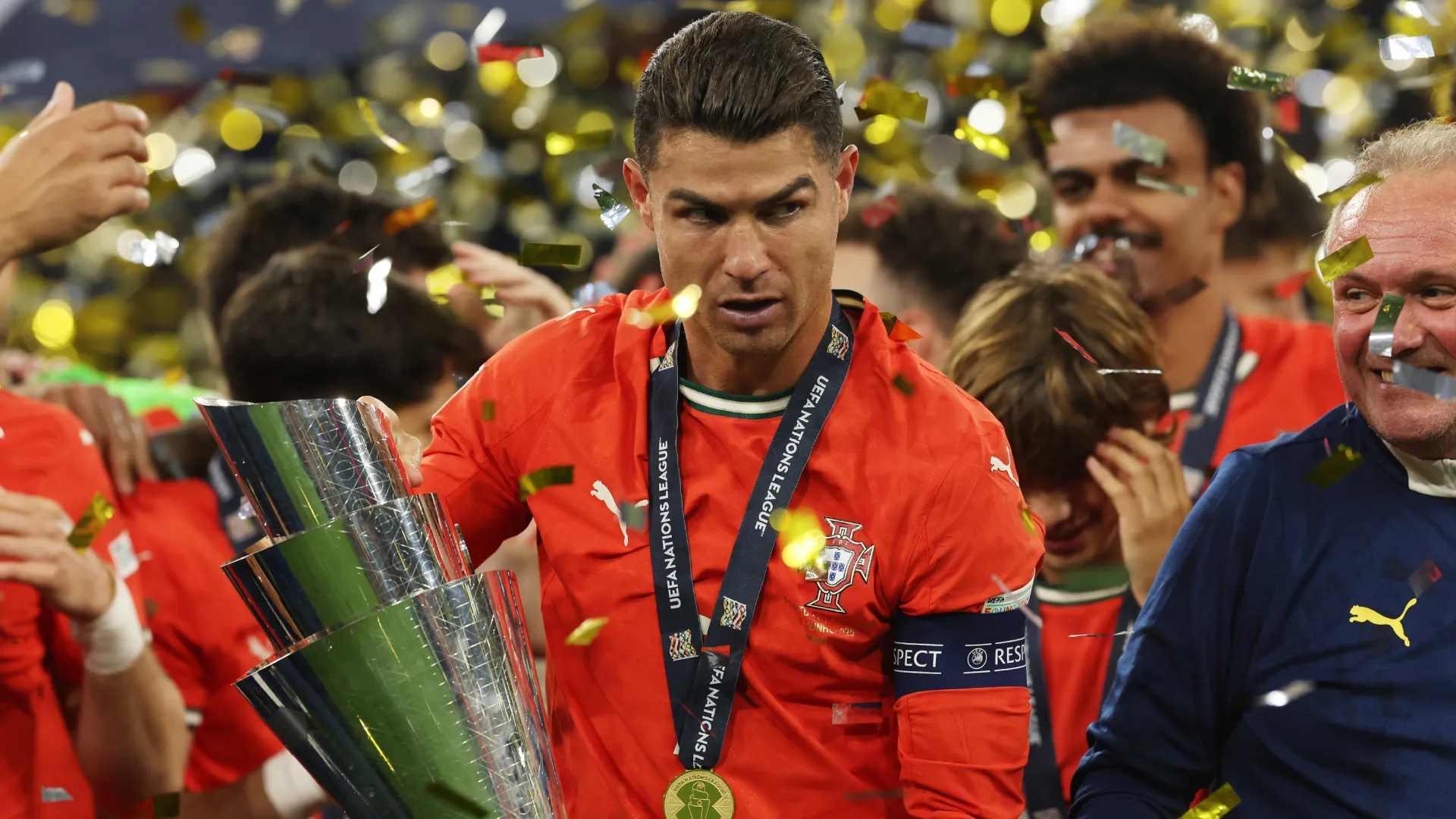
Cristiano Ronaldo of Portugal holds the UEFA Nations League trophy
The Portuguese Football Federation responded to his announcement with “deep gratitude and immense admiration”, describing him as an inspiration to generations of young players. It also confirmed plans to organize a tribute so supporters can celebrate his contribution to the national team.
Ronaldo vs. Eusebio: How do their numbers compare?
The comparison between Ronaldo and Eusebio highlights two different forms of greatness. Ronaldo holds the advantage in overall appearances, goals, World Cup participation, and international trophies, while Eusebio maintains a slightly better international scoring rate.
Ronaldo’s 146 goals came across more than two decades of international soccer, while Eusebio scored 41 times in just 64 appearances. The legendary Benfica forward therefore holds a marginally higher goals-per-game average, demonstrating how dangerous he was in front of goal during his era.
| Statistic | Cristiano Ronaldo | Eusebio |
| Active Years | 2003–2026 | 1961–1973 |
| Appearances (Caps) | 234 | 64 |
| Goals | 146 | 41 |
| Goals Per Game | 0.62 | 0.64 |
| Major Trophies | 2 (Euro 2016, Nations League 2019) | 0 |
Eusebio’s greatest international achievement came at the 1966 World Cup, where he scored nine goals to win the Golden Boot and helped Portugal finish third. His four-goal performance against North Korea in the quarter-finals remains one of the tournament’s most memorable displays.
| World Cup Metric | Cristiano Ronaldo | Eusebio |
| Tournaments Played | 6 (2006, 2010, 2014, 2018, 2022, 2026) | 1 (1966) |
| Matches Played | 27 | 6 |
| Goals Scored | 11 | 9 |
| Goals Per World Cup Game | 0.41 | 1.50 |
| Golden Boot Awards | 0 | 1 (1966) |
| Best Team Finish | 4th Place (2006) | 3rd Place (1966) |
Ronaldo, meanwhile, scored 11 goals across six World Cups, becoming the first player to score at six different editions. Although his tournament record spans a much longer period, Eusebio’s extraordinary 1966 campaign remains a benchmark for Portugal’s World Cup history.
| Euro Metric | Cristiano Ronaldo | Eusebio |
| Tournaments Played | 6 (2004, 2008, 2012, 2016, 2020, 2024) | 0 |
| Matches Played | 30 | 0 |
| Goals Scored | 14 | 0 |
| European Titles | 1 (2016) | 0 |
Two legends, two different legacies
Eusebio became Portugal’s first global soccer superstar, winning the 1965 Ballon d’Or and establishing himself as a Benfica icon. His 1966 World Cup performances introduced the country to a worldwide audience, laying the foundations for future generations.
| Award / Honor | Cristiano Ronaldo | Eusebio |
| Ballon d’Or | 5 (2008, 2013, 2014, 2016, 2017) | 1 (1965) |
| FIFA Men’s Player of the Year | 3 (2008, 2016, 2017) | N/A (Award created in 1991) |
| European Golden Shoe | 4 (2008, 2011, 2014, 2015) | 2 (1968, 1973) |
| World Cup Golden Boot | 0 | 1 (1966) |
| European Cup / UCL Top Scorer | 7 | 3 (1965, 1966, 1968) |
Ronaldo took that legacy to another level through unprecedented longevity and a collection of international records. Most importantly, he delivered major trophies that had eluded Portugal throughout Eusebio’s playing career.
| Statistic | Cristiano Ronaldo | Eusebio |
| Matches Played | 183 | 64 |
| Goals Scored | 140 | 46 |
| Goals Per Game Average | 0.77 | 0.72 |
| European Titles Won | 5 (2008, 2014, 2016, 2017, 2018) | 1 (1962) |
The debate over which player deserves the title of Portugal’s greatest will likely continue for generations. However, their contributions remain inseparable from the country’s soccer history, with Eusebio opening the door and Ronaldo building on that legacy through an extraordinary 23-year international career.
| Trophy Type | Cristiano Ronaldo | Eusebio |
| European / Continental Titles | 5 (1 Man Utd, 4 Real Madrid) | 1 (Benfica) |
| Domestic League Titles | 7 (3 Premier League, 2 La Liga, 2 Serie A) | 11 (Primeira Liga) |
| Major Domestic Cups | 4 (1 FA Cup, 2 Copa del Rey, 1 Coppa Italia) | 5 (Taça de Portugal) |
| FIFA Club World Cup | 4 | 0 |