



When I first heard that Didier Drogba’s story was being told in comic form, I waited in eager anticipation to get my hands on the book. See, I read comic books on a weekly basis and head straight to my local comic store after work each Wednesday to pick up new issues. I do this largely because I think some of the best stories being told right now are in comic books. Yes, comics have the stigma of being for children, but there are some rich, vibrant characters and plots in modern day comic books.
After reading Didier Drogba: Part 1: From Tito to Drogba, it’s absolutely clear that the author, Gabin Bao, developed this story for a younger audience. That said, Drogba has lived quite an interesting life, becoming a paragon of sorts to an entire continent, and some of those themes peeked out just enough to keep me reading.
Let’s start with the writing, as that’s the backbone of any book. The story itself stays true enough to Drogba’s life, which, as I stated before, is fascinating. There are times when the depiction of the Ivorian striker seems a bit too perfect to be true. A bit of a character flaw is introduced while telling the story of his failing grades as a young student and his attempt to forge his aunt’s signature on a failed test, but apart from that, this book leaves out any negative aspects of his character. The book is also largely devoid of conflict aside from a couple of panels that showed he had to sneak out to train before his father could stop him; a subplot that evolves into nothing. Finally, while the grammar suffices, it’s clear that English was not the first language this comic was written in. There are awkward bits of dialogue scattered throughout that cause the characters to feel a bit stiff an unnatural.
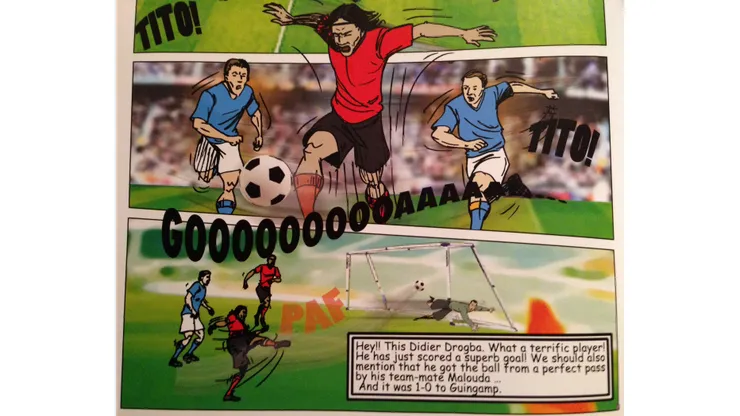
The artwork is perhaps the book’s strongest part. Sketches and filtered, photorealistic backgrounds merge to create an interesting juxtaposition. I was, at times, a little unnerved at the fact that every character is smiling in every single frame, but it grows on you after awhile. On the subject of frames, this book follows the traditional style of varying frame sizes and positioning seen in just about every comic book. The composition stays fairly traditional though and the progression of frames is easy enough to follow, even for the youngest reader.

There are a few instances in From Tito to Drogba that had me yearning for more. One moment in particular takes place right after his initial call up to the Ivory Coast at a time when his nation was split by an armed rebellion. The war obviously played a large part in Didier’s life and his future endeavors for the Ivory Coast and all of Africa, but the conflict is only mentioned on a single page before we cut back to Drogba on the pitch.
Part one of the striker’s life story ends with his transfer to Chelsea. The closing pages are perhaps the most engaging as they depict his struggle in making the decision to leave Marseille for the London club. Drogba’s current devotion to Chelsea is obvious, but he really wrestled with the initial transfer, which is explained in perhaps the most complete subplot in the entire book. There’s also a really great story of what happened when Drogba and Mourinho first met, but I won’t spoil that.
Ultimately, Didier Drogba: Part 1: From Tito to Drogba is intended for a younger reader who appreciates not only Drogba, but simply the sport of soccer. While adult readers will be found wanting, the first part of this comic life of Drogba would make a great gift for a young soccer player, particularly if he or she was just starting to read.