

Nairobi (AFP) – Henry Eshiboko considers himself privileged. The 20-year-old lives with his wife and child in a single, windowless, nine square metre room.
The tin roof and walls are held firm by wooden beams so there are no leaks when it rains, there is a power socket and, a little way down the alley, a shared water tap.
“This is all thanks to football!” said the local club left winger and resident of Kibera, a huge slum in the heart of the Kenyan capital Nairobi.
“With the 300 shillings ($2.9; 2.7 euros) I get for training, four times a week, I can feed my family and pay a part of the rent,” said Eshikobo.
Win bonuses are worth 10 times more. “With the match bonus, we can buy clothes, kitchen stuff and a few extra things. Right now, my wife is at the hairdresser!” he said, his face lighting up as it does whenever he speaks of football or family.
In Kibera, a labyrinth of uneven paths crisscrossed by rivers of sewage, Eshiboko’s life is akin to luxury: 80 percent of the population does not have access to electricity, and many survive on less than a dollar a day.
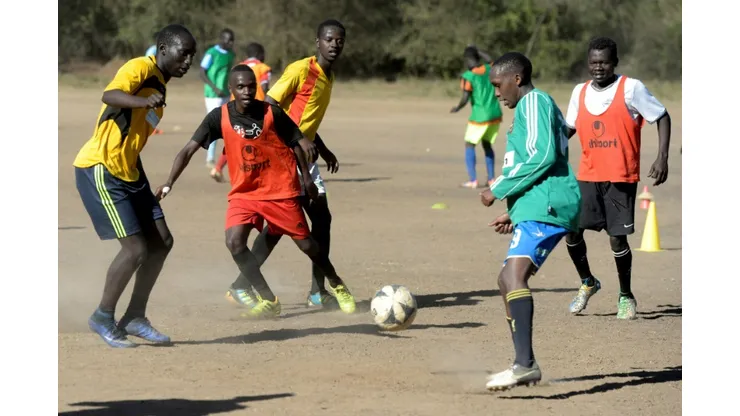
Three back-to-back low league titles made the Black Stars — Eshiboko’s team, not the Ghanaian national side of the same name — into ghetto superstars and this year they play in Kenya’s national second division for the first time.
“Some of our matches are even on television,” said Eshiboko.
– Winning games, winning support –
Before their rapid rise the team languished in lower divisions for years, but the club restructured and began to pay bonuses, said coach Godfrey Otieno, a former professional player who opted to remain in his native Kibera “to be able to give back to young people”.
“Before, it was common to have only six or seven players for training,” the 42-year-old said, pointing out that asking for four mornings a week as well as weekends without financial compensation “was difficult”.
“Now, everyone is here, and on time,” Otieno said.
For the players, football is a way to defy destiny.
“It’s not because we come from Kibera that we can’t do anything, or that we cannot have ambitions,” said Eshiboko.
“When people talk about Kibera, they generally talk about crime, drugs, poverty. We have our issues, we’re not denying this, but with football, we prove that Kibera is more than that.”
For its fans, the team is a source of pride.
“We love the spirit of this team, it is people who come from Kibera who play and represent us,” said Bildad Ilondounga, an ardent Black Stars supporter.
“When we look at the field, we see our neighbours playing, and when the players look at the edge of the field, they see their neighbours.”
Adding to the club’s local popularity is the players’ willingness to donate food and clothes to families in need when they are able, while part of the Black Stars’ meagre budget goes to fund a slum kids’ team and buy them an after-training meal.
There are occasional perks for the players too.
“There are times when I take the bus, I don’t have to pay the fare because people say, ‘He is a Black Star!’,” laughed Eddy Odhiambo, a 21-year-old striker.
– Smalltime, big dreams –
But success brings its own challenges.
Operating in the national second division the club now has to pay for long cross-country trips to away matches as well as renting a decent quality home pitch.
For years the club has been almost exclusively financed by a French teacher living in Nairobi who helped develop the Black Stars, but even with new sponsors there is not enough to cover this season’s budget, estimated at $70,000 (66,000 euros).
“The level is going up, and we would like to give contracts to players, like other National Super League teams do, but it’s not possible,” said Otieno, adding that the Black Stars was up against teams with far bigger budgets this year.
Under these difficult conditions adapting to the second division has been tough and despite their improvements the Black Stars have lost four of five matches so far this season.
“That means less money, it is hard,” said Eshiboko.
They are also struggling without their hardcore group of about 4,000 fans who would gather when they played in the heart of Kibera in the past. The new, better quality pitch is a 1.80 euro bus ride away — out of reach for most of Kibera’s football-loving residents.
Like smalltime players everywhere the teammates dream of the European leagues.
Eshiboko is learning French through a partnership with Nairobi’s branch of the Alliance Francaise, a French language and cultural institute, and has his eye on Ligue 1 team Monaco, while Odhiambo is less picky: he’d settle for “any club, in France or in England”.
Their coach shares this seemingly impossible dream. “If one or two players in the team can go to Europe to play football, we have achieved our goal,” said Otieno.