



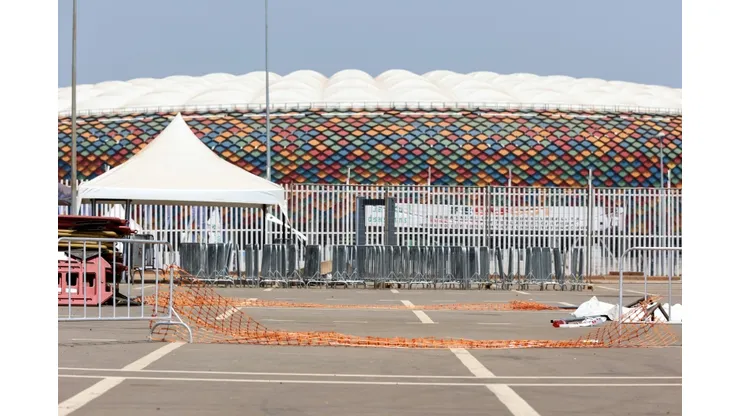
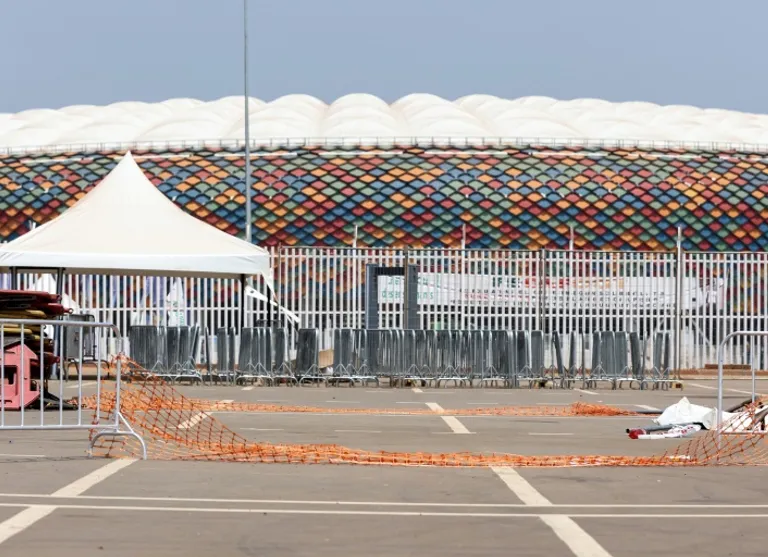
Yaoundé (AFP) – The Africa Cup of Nations which finishes this weekend in Cameroon will remain forever scarred by the crush which killed eight people at the Olembe Stadium after a month in which the tournament’s organisers struggled from one problem to another.
The spectacular 60,000-seat Olembe Stadium in the capital Yaounde was built to be the jewel in the crown of Cameroon’s Cup of Nations, at an official cost of some 163 billion CFA francs ($284 million).
Its name will now always be associated with the events of January 24, when eight died and 38 were injured in the crush and stampede at the stadium’s southern entrance gate.
The ground was temporarily closed but reopened 10 days later for the semi-final between Cameroon and Egypt, yet the disaster put people off to such an extent that only 24,371 people attended that match.
That was just 40 percent of capacity, when up to 80 percent of seats could have been filled in line with Covid-19 restrictions in place for the tournament.
“When people die it makes everybody afraid,” one supporter, Valentin Kamga, told AFP as he made his way to the stadium for its reopening.
Cameroon will struggle to shake off the legacy of Olembe, despite the hugely stepped-up security subsequently put in place.
“Moments of joy can be accompanied by moments of sadness,” Cameroon legend Rigobert Song told AFP. “There is a feeling of sadness but it is part of life.”
– Delays –
Cameroon had been afforded plenty of time to get ready to host its first Cup of Nations since 1972.
It was supposed to host the competition in 2019 only to be stripped of the tournament due to delays in preparations, with Egypt stepping in.
The Cup of Nations was then postponed last year because of the pandemic.
Yet still not everything was ready, and media facilities at the stadium in Limbe were never completed by the time the action started.
Local organisers were not helped by the Confederation of African Football, which decided with just four days’ notice to strip the Japoma Stadium in the economic capital of Douala of a quarter-final and a semi-final, moving both to Yaounde.
There were concerns about the state of the pitch, but no official explanation for the change was ever offered, and CAF also decided at the last minute to bring forward the third-place play-off by a day.
The tournament was plagued by poor attendances, even in this football-mad country.
CAF imposed strict conditions to enter stadiums, with supporters needing to be fully vaccinated and provide proof of a negative test, enough to deter many in a country with low vaccination rates.
Crowds did improve as the tournament progressed, but the Olembe disaster appeared to be the final straw for many.
– Lessons for next year –
There have been plenty of uplifting moments, from Burkina Faso’s run to the semi-finals despite a military coup at home, to tiny Gambia reaching the last eight in their debut appearance.
Fellow minnows the Comoros made the knockout stages and only lost narrowly to the hosts despite having to play an outfield player in goal after being ravaged by Covid cases.
That evening, however, was quickly overshadowed by the disaster unfolding outside at Olembe.
“In sporting terms we saw some great matches, but we didn’t get the best two teams in the final,” Cameroon’s 1990 World Cup star Roger Milla told AFP.
Despite the presence of world-class players like Egypt’s Mohamed Salah, Senegal’s Sadio Mane and Algeria’s Riyad Mahrez, the football on the field did not always match expectations.
There were just 100 goals scored in 51 games before the final, an average of 1.96 per game — identical to the 2019 edition.
On the field but especially off it, the hope is that the next Cup of Nations proves more uplifting.
There is not long, with the Ivory Coast set to host the tournament in June and July 2023, just six months after the World Cup in Qatar and during the rainy season, which may bring its own challenges.