

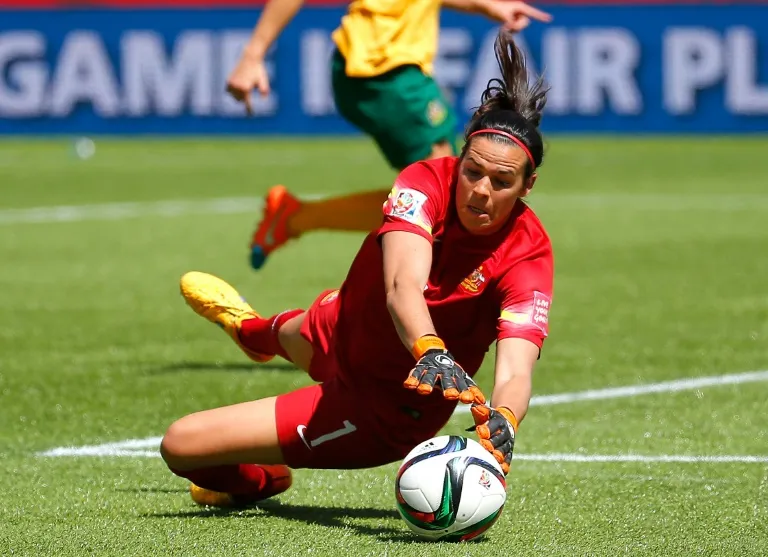
Sydney (AFP) – When Australia’s “golden generation” of women footballers begin their World Cup campaign in France on Sunday, veteran goalkeeper Lydia Williams will be flying the flag not just for her country but also for her indigenous heritage.
One of Australia’s most successful players, Williams’ mother was a missionary from the United States and her father an Aboriginal elder.
Williams grew up playing sport in the red dust of Australia’s outback and even had kangaroos for pets.
“When I first started (playing elite football), I wanted to leave the game better than when I first came in,” the 31-year-old said ahead of her fourth World Cup campaign for the Matildas, “leaving my mark in whatever way, shape or form that’s possible.
“Hopefully inspiring younger generations — whether it is goalkeepers or players, or indigenous people to come and play the game — that is my biggest goal.”
But football lags other Australian sports when it comes to indigenous recognition, with pathways in remote areas slow to emerge.
It stands out among top-tier sports in Australia for lacking a dedicated indigenous round in its men’s A-League and women’s W-League premier competitions.
Advocates say the absence of indigenous artwork on the Matildas World Cup kit is a missed opportunity, with recognition of Australia’s culture dating back thousands of years gaining more traction in other sports.
Rugby league and Australian Rules have targeted grassroots programmes in remote areas and unearthed some of the country’s greatest talent with indigenous representation in those sports running at about 10 percent for the premier men’s competitions.
Footballers with an Aboriginal background make up less than two percent of A-League and W-League squads; indigenous Australians comprise about three percent of the national population of 25 million.
“There are a lot of kids that are keen on our football, but don’t have the opportunities in today’s modern football programmes,” the first Aboriginal selected for Australia, John Moriarty, told AFP.
– Role Models –
The FFA hall-of-famer comes from Borroloola, a tiny Northern Territories town with a population of about 900 people more than 3,000 kilometres (1,860 miles) from Sydney in the Gulf of Carpentaria.
He launched a football foundation there to tackle poor health and education issues which affect remote communities.
“It is those types of barriers that we are hopeful in breaking and bringing kids through to that level, where we think they can achieve greater aspects in their lives,” he said.
Borroloola is also the home town of Australia Under-20 international Shadeene Evans, who at 13 traded barefoot futsal on concrete basketball courts for boots and the lush green pitches of Sydney.
Teenager Evans is a star of Moriarty’s foundation who started her W-League career at premier Sydney FC last season and generates a buzz whenever she returns home.
“Even the young ones look up to me. It is great seeing the community get behind me,” the highly-rated 17-year-old told AFP.
Moriarty said it was role models such as Evans and Williams who “will give our kids the inspiration to achieve themselves”, although more are needed.
But the Football Federation Australia (FFA) has been criticised for not providing a prominent platform for its indigenous stars, while several initiatives over the past decade to boost Aboriginal participation have stalled.
“We’ve had a sporadic commitment which hasn’t lived up to the rhetoric or the responsibility and we need to do more,” Socceroos legend and long-term indigenous football advocate Craig Foster told AFP.
– Grass roots –
Foster points to community-led initiatives such as the annual Australian Indigenous Football Championships — which this year yielded national indigenous men and women teams — as important areas of growth.
“Like many other fields of Australian society, what is critically important is indigenous Australia owns their own participation in the game,” he said.
Governing bodies should provide “institutional support” and “government connections” to help nurture indigenous football, Foster added.
The Wallabies rugby union national side recently staged a high-profile launch of an indigenous-themed away kit to be worn at the World Cup in Japan later this year.
Foster said it was a “glaring oversight” that the Matildas had not adopted regalia demonstrating “respect and pride” of indigenous culture while on the world stage.
“Football can not only make this connection in Australia, it can make it around the world,” he said.
Ros Moriarty, chair of the recently established FFA women’s council, said football is a “great leveller” for embracing diversity, but many levels of “equality of care” need addressing in the women’s game Down Under.
“I think France will show us where Australia sits,” she told AFP.
“And part of that is on the field and probably more of that is how do we compare with opportunity and care that hasn’t been evident yet in football globally.”