



The Australian national team arrives in North America having shed its long-held underdog label. As fans search for a definitive World Cup 2026 team preview, the Socceroos stand out as a tactically resilient roster under coach Tony Popovic.
Following an impressive run at the previous global tournament, expectations have naturally elevated. Drawn into a highly competitive Group D alongside the United States, Turkey, and Paraguay, Australia aims to disrupt the established hierarchy among the FIFA World Cup 2026 teams.
This article delivers essential Australia tactical analysis, highlights Australia key players, and evaluates their realistic chances of advancing this summer.
Team profile
| Coach | Tony Popovic |
| Captain | Mathew Ryan |
| Nickname | Socceroos |
| FIFA Ranking | 27th |
| Confederation | AFC |
| Group | Group D |
| Best tournament result | Round of 16 (2006, 2022) |
| Tournament appearances | 7 (including 2026) |
| Last appearance | 2022 |
How Australia play
Australia will likely utilize a structured 3-4-2-1 formation that prioritizes defensive solidity and rapid transitions. Under Popovic, the squad has grown comfortable operating without the ball.
They rely heavily on a high-intensity pressing system to disrupt opponents and launch clinical counter-attacks. The system demands significant output from the wing-backs, with players like Jordan Bos expected to push forward into the penalty area while maintaining defensive responsibilities.
In the center of the pitch, combative midfielder Jackson Irvine anchors the team. His ability to break up play and quickly distribute the ball is essential for launching offensive transitions.
While the team conceded just 0.44 goals per 90 minutes during qualification, their underlying metrics showed a 1.13 expected goals against (xGA) average. This suggests opposing attacks did find open spaces. If the defensive spine can tighten those gaps, this transition-heavy approach could frustrate possession-oriented opponents in the upcoming tournament.
Tony Popovic: The coach behind Australia
Tony Popovic stepped into the head coaching role in September 2024, inheriting a squad in the midst of a qualification crisis. He quickly stabilized the team, leaning on his reputation as a meticulous disciplinarian to instill much-needed mental resilience.
The Australia coach brings significant international pedigree, having earned 58 caps as a commanding center-back during his playing days. His managerial resume is highlighted by a historic AFC Champions League title with the Western Sydney Wanderers in 2014.
Known for his no-nonsense leadership style, Popovic demands peak physical fitness and unwavering concentration from his roster. His ability to organize a disciplined defensive unit and inspire confidence under pressure will be the defining factor in how the Socceroos navigate the challenges of the global competition.
Key player: Nestory Irankunda
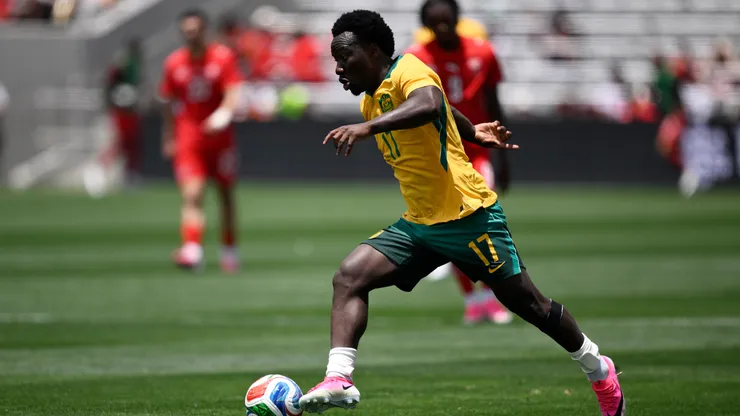
At just 20 years old, Nestory Irankunda represents the dynamic X-factor for the Australian attack. The Watford winger possesses a rare blend of pace, technique, and directness that forces opposing defenses to retreat.
This aggressive forward movement naturally opens vital pockets of space for the midfield to exploit. Irankunda is a constant threat from distance and dead-ball situations, capable of producing moments of brilliance even when his team is starved of possession.
To maximize his impact on the international stage, he must balance his attacking flair with the strict defensive tracking that his coach demands. If Irankunda can maintain emotional consistency and perform at his peak, he provides the game-changing spark necessary for the Socceroos to advance.
Australia’s road to the 2026 World Cup
Australia’s qualification journey was a campaign of two distinct halves. They cruised through the second round with a perfect record, but stumbled early in the decisive third phase.
A shock home defeat to Bahrain prompted a mid-campaign coaching change. The team quickly adapted to a more resilient style, ultimately finishing second in AFC Group C behind Japan.
They secured automatic qualification with a record of five wins, four draws, and one loss in the final round. The defining moment arrived late in the schedule with a gritty 1-0 victory over Japan, proving this roster can execute a disciplined game plan against elite competition.
Australia’s 2026 World Cup group stage outlook
The Socceroos face a demanding path through Group D, where they will compete against the United States, Turkey, and Paraguay. While statistical models position them as the underdogs of the quartet, the margins between these four nations are incredibly tight.
The matchup against the host nation, the United States, presents the most hostile environment and arguably the toughest challenge. Conversely, the critical matchday three fixture against Paraguay could serve as the most favorable opportunity to secure essential points.
Qualification will likely hinge on Australia’s ability to frustrate their opponents defensively and steal narrow victories. A top-two finish is entirely realistic if their structured game plan holds firm under pressure.
Readers looking to follow every match involving the Socceroos can also check our complete Australia TV schedule for the latest broadcast and streaming information.
Australia 2026 World Cup squad
| Player (Position) | Club |
|---|---|
| Mathew Ryan (GK) | Levante |
| Paul Izzo (GK) | Randers |
| Patrick Beach (GK) | Melbourne City |
| Miloš Degenek (DF) | APOEL |
| Harry Souttar (DF) | Leicester City |
| Jacob Italiano (DF) | Grazer AK |
| Jordan Bos (DF) | Feyenoord |
| Kai Trewin (DF) | New York City |
| Aziz Behich (DF) | Melbourne City |
| Jason Geria (DF) | Albirex Niigata |
| Cameron Burgess (DF) | Swansea City |
| Alessandro Circati (DF) | Parma |
| Lucas Herrington (DF) | Colorado Rapids |
| Connor Metcalfe (MF) | St. Pauli |
| Ajdin Hrustic (MF) | Heracles Almelo |
| Jackson Irvine (MF) | St. Pauli |
| Aiden O’Neill (MF) | New York City |
| Paul Okon-Engstler (MF) | Sydney FC |
| Cammy Devlin (MF) | Heart of Midlothian |
| Tete Yengi (FW) | Machida Zelvia |
| Cristian Volpato (FW) | Sassuolo |
| Mathew Leckie (FW) | Melbourne City |
| Nestory Irankunda (FW) | Watford |
| Awer Mabil (FW) | Castellon |
| Nishan Velupillay (FW) | Melbourne Victory |
| Mohamed Touré (FW) | Norwich City |
Final word on Australia
Australia enters the global tournament in a position of quiet confidence. Their defensive solidity and tactical discipline serve as the bedrock of their campaign, giving them a genuine chance to frustrate the top international soccer teams 2026 will showcase.
However, their ultimate success will depend on whether unproven attacking talents can consistently convert limited scoring opportunities.
Escaping the group stage remains a realistic and achievable expectation. If the backline holds firm, the Socceroos possess the resilience required to secure a consecutive appearance in the knockout rounds.