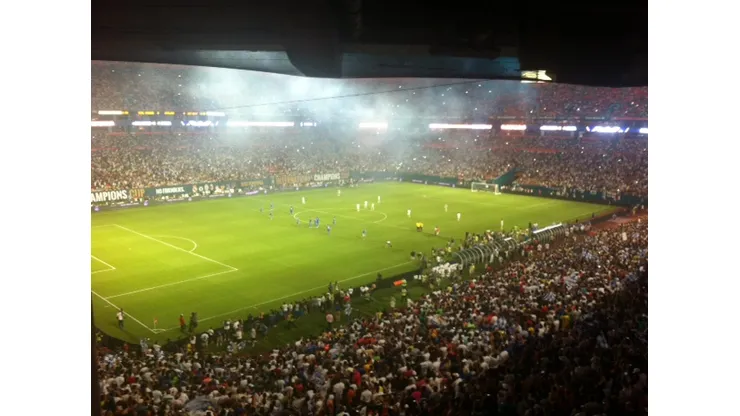

After news leaked this week that the Premier League is exploring possibilities about expanding globally to include league games played overseas in select markets, many in the English media were quick to share their disdain for the idea even though the chairman of one Premier League club (Huw Jenkins, Swansea) said “There’s definitely going to be a run of games played abroad in 12 months or two years. That’s where it’s going to be and where the money is.”
Not surprisingly, money is the motivating factor in enticing Premier League chairman to vote yes to foreign expansion if and when the opportunity arises. But other than the financial gain for clubs who want to be more competitive in the UK and Europe, the more sensitive issue is what the change would mean for fans or supporters who are the ones that will be impacted most significantly by the change.
I would argue, however, that football supporters in the UK need to accept the change. I believe it’s time for the Premier League to play select games overseas, for the following reasons:
1) The concept of ‘local’ has changed.
Globalization, mainly due to the accessibility of television and the Internet, has made borders seem less significant. Many of us, no matter where we live around the world, are watching the same soccer games. A soccer fan is watching a live Manchester United game from his flat in London while another soccer fan, glued to the same match, is watching it in his Brooklyn apartment. The coverage of the game is beamed to TV sets around the world. The person overseas feels as connected to the game and the experience as the fan who lives 200 miles from the stadium.
The same can be said if and when a Premier League match is played overseas. The fans watching the game on television in the UK will feel just as connected to the match as those viewing the game on TV sets around the world.
2) Let it go.
If you remove traditionalism and the fear of change from the equation, why are some Brits afraid to let go of “their” league? What is the root of their opposition to the idea?
Plausible concerns are that the club could lose its identity, that the games abroad could loss their competitiveness and the whole events could escalate into a media circus where the games become secondary. But if we know anything, it’s that the Premier League is a well run organization that focuses a lot of its intention on the details. The league and clubs would need to treat the games very seriously, limit the amount of media attention and let the games do the talking.
The people running the Premier League and its 20 clubs are, for the most part, smart businessmen that understand they need to find the balance between commercialism and authenticity. The league and the clubs are in a long-term business venture, creating what is arguably Britain’s most popular export. They will do everything they need to do to grow incrementally without ruining the brand of the clubs or Premier League.
3) Disruption is minimal.
By the way that some Brits are arguing, you would think that the Premier League was planning on exporting all of the games overseas when in reality it’ll probably only be one or two games per club. British football supporters will still be able to enjoy the highs and lows of a typical season with minimal disruption. They’ll still be able to see the vast majority of games in person in the UK.
4) The soul of clubs will remain intact.
Out of the 20 clubs in the Premier League, only 3 of them play on the same hallowed turf where the club was originally founded. The vast majority of Premier League clubs have moved to new, giant monolith stadiums. Yet the soul of the clubs has remained intact. Therein, by clubs playing one home match away from its home ground each season on foreign land, it’s not going to cause any damage.
5) Foreign supporters are just as loyal and passionate about “your” club.
It can be argued that many supporters overseas are more loyal and passionate about their club than many supporters in the UK. Many of these foreign fans wake up on a weekly basis in the middle of the night to drive to a pub to watch the games with their fellow supporters. These are fans who have been supporting their club for decades, spending enormous amounts of money on merchandise and club memberships. These fans invest more of their time and energy supporting their club than many fans in the UK. So what gives football supporters more of a right in the UK to see their club while more deserving fans abroad have been largely ignored until now?
To put things into perspective, the Premier League will receive nearly $8.8 billion in TV rights fees from TV companies worldwide from 2013-16. Of that total, $1.47 billion will come from Asia alone.
English football supporters shouldn’t worry. Foreign supporters of Premier League clubs will be just as loyal and passionate about “your” club. If anything, the response from foreign supporters may surprise some Brits and give them a better appreciation of the millions of foreign fans worldwide.
6) Benefits far outweigh the negatives.
For decades, Premier League clubs, managers and supporters have been complaining about the use of FA Cup replays and two-legged League Cup semi-finals that cause fixture congestion and often are more disruptive than they ought to be. To this day, nothing has changed even after repeated requests by England national team managers. Now, all of a sudden, there’s finally an opportunity to get rid of the replays and to end FA Cup replays and two-legged League Cup semi-finals for good.
The Premier League has already been a trailblazer in the growing popularity of the sport worldwide. With countless hours spent by adoring fans worldwide, as well as huge sums of money poured into the league from foreign TV providers, the time is now to expand the Premier League globally. We’re not asking for much other than an opportunity to see some of the games in our own country. The shift won’t change anything about the game we all love except that it’ll give fans a chance to see games in person that may otherwise not be possible. Let’s give foreign fans a mere slice of the entertainment that fans in the UK have been able to enjoy week-in week-out for years.
Hypothetical schedule and locations of Premier League games to be played overseas:
QPR v Manchester United (Los Angeles)
Manchester City v Burnley (Dubai)
Swansea vs Arsenal (Toronto)
Tottenham vs Leicester (Hong Kong)
Stoke vs Liverpool (Singapore)
Chelsea vs West Bromwich Albion (Miami)
Everton vs Crystal Palace (Bangkok)
West Ham United vs Southampton (Sydney)
Aston Villa vs Sunderland (Kuala Lumpur)
Newcastle United vs Hull City (Johannesburg)
200+ Channels & Local Sports
- Price: Plans starting at $14.99/mo (Latino)
- Watch Ligue 1, Copa Libertadores & World Cup Qualifiers
Every MLS Match in One Place
- Price: $12.99/mo (Now included with standard subscription)
- Watch every MLS regular season game, Playoffs & Leagues Cup
Many Sports & ESPN Originals
- Price: $11.99/mo (or ESPN Unlimited for $29.99/mo)
- Features LaLiga, Bundesliga, FA Cup & NWSL
2,000+ Soccer Games Per Year
- Price: Starting at $8.99/mo
- Features Champions League, Serie A & Europa League
Home of the Premier League
- Price: Starting at $10.99/mo
- 175+ Exclusive EPL matches per season