




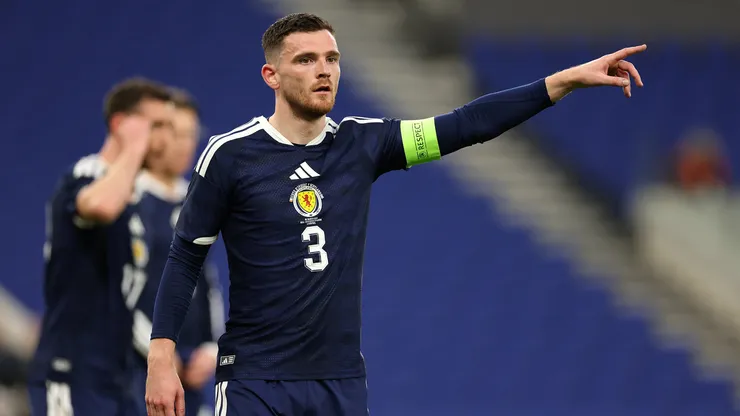
After a 28-year absence, Scotland returns to the global stage for the 2026 tournament in North America. The national team has appeared in eight previous editions of the competition but has never advanced past the group stage. Now, this modern roster is eager to rewrite history.
As one of the most intriguing FIFA World Cup 2026 teams, the squad has transformed from a gritty underdog into a tactically disciplined unit capable of challenging elite opponents. Armed with in-form stars like Scott McTominay and John McGinn, they combine relentless work rate with technical quality.
As they prepare to navigate a challenging group, expectations are higher than ever for a historic run to the knockout rounds.
Team profile
| Coach | Steve Clarke |
| Captain | Andy Robertson |
| Nickname | The Tartan Army |
| FIFA ranking | 43rd |
| Confederation | UEFA |
| Group | C |
| Best tournament result | Group stage |
| Tournament appearances | 8 |
| Last appearance | 1998 |
How Scotland play
Under Steve Clarke, the Scotland formation is built on a pragmatic and defensively robust foundation. The team typically utilizes a three-man backline, relying on structural discipline to frustrate opponents.
However, their tactical evolution during the recent qualification cycle showcased a surprising attacking edge. Any comprehensive World Cup 2026 team preview must highlight how the team proved they could thrive in open play, averaging an impressive 2.2 goals per game in their group.
This shift relies heavily on the attacking freedom granted to midfield runners. Players like McTominay provide a crucial goal-scoring threat from deep positions, changing the entire dynamic of the Scotland tactical analysis.
Despite these improvements in the final third, underlying metrics highlight a glaring vulnerability in transition. When the wing-backs push high up the field to join the attack, the defensive trio is frequently left exposed to elite pace on the counter-attack.
Steve Clarke: The coach behind Scotland
Appointed in May 2019, Steve Clarke is now the longest-serving Scotland coach in history. He has overseen a highly successful era for the national team, ending a decades-long absence from major competitions by qualifying for back-to-back European Championships.
Before taking the national team job, Clarke built a strong coaching resume. He served as an assistant during a trophy-laden spell at Chelsea and later managed West Bromwich Albion in the Premier League.
His philosophy centers on defensive solidity and collective effort, traits that have defined his international tenure. While he boasts a solid 43.4% win rate over 76 matches, his leadership and tactical adjustments will be the defining factor in whether this squad can finally secure a major finals victory.
Key player: Scott McTominay
Scott McTominay is the undeniable engine driving this modern Scottish side. The Napoli midfielder possesses the physical presence to dominate the center of the field, but his knack for scoring crucial goals elevates him to elite status.
Since moving to Italy, he has flourished as an attacking threat. He netted 12 league goals during the 2024-25 season to help secure a domestic title, followed by another 10-goal campaign the next year.
Unlike his previous club roles, he is granted the freedom to crash the penalty area and operate as a shadow striker. The Scotland 2026 World Cup squad relies heavily on his production to break down opposing defenses.
Scotland key players must perform at their peak for the team to succeed, and McTominay is the most vital piece of the puzzle. If he is unavailable, the team’s primary route to goal completely disappears.
Scotland’s road to the 2026 World Cup
The Tartan Army defied expectations by finishing at the top of UEFA Group C, securing their first direct qualification to the global stage since 1998. They recorded four wins, one draw, and a single defeat during the campaign, scoring 13 goals in the process.
The defining moment arrived in the final round of matches against a heavily favored Denmark side. Needing a result, the team delivered a stunning 4-2 victory in Glasgow, highlighted by an unforgettable bicycle kick from McTominay.
By outscoring elite opposition and showing remarkable resilience, this qualification run proved the squad is no longer just a gritty underdog. They are a legitimate threat entering the summer competition.
Scotland’s 2026 World Cup group stage outlook
Drawn into Group C alongside Brazil, Morocco, and Haiti, the path to the knockout rounds is clear but demanding. The opening match against Haiti in Foxborough is widely considered the most favorable matchup.
Securing three points and a strong goal differential in this opening game is absolutely critical for advancement. Without a victory here, progressing to the next round becomes highly unlikely.
Readers looking to follow every match involving the national team can also check our complete Scotland TV schedule for the latest broadcast and streaming information.
The subsequent tests will be significantly harder. Morocco represents a formidable challenge with elite technical ability, while the group finale against five-time champions Brazil is the most difficult match on paper. Success hinges entirely on maximizing points early.
Scotland squad for 2026 World Cup
| Player (Position) | Club |
|---|---|
| Craig Gordon (GK) | Heart of Midlothian |
| Angus Gunn (GK) | Nottingham Forest |
| Liam Kelly (GK) | Rangers |
| Nathan Patterson (DF) | Everton |
| Andy Robertson (DF) | Liverpool |
| Grant Hanley (DF) | Hibernian |
| Kieran Tierney (DF) | Celtic |
| Jack Hendry (DF) | Al-Ettifaq |
| John Souttar (DF) | Rangers |
| Dominic Hyam (DF) | Wrexham |
| Aaron Hickey (DF) | Brentford |
| Anthony Ralston (DF) | Celtic |
| Scott McKenna (DF) | Dinamo Zagreb |
| Scott McTominay (MF) | Napoli |
| John McGinn (MF) | Aston Villa |
| Tyler Fletcher (MF) | Manchester United |
| Ryan Christie (MF) | Bournemouth |
| Lewis Ferguson (MF) | Bologna |
| Kenny McLean (MF) | Norwich City |
| Ben Gannon-Doak (MF) | Bournemouth |
| Findlay Curtis (MF) | Kilmarnock |
| Lyndon Dykes (FW) | Charlton Athletic |
| Ché Adams (FW) | Torino |
| George Hirst (FW) | Ipswich Town |
| Lawrence Shankland (FW) | Heart of Midlothian |
| Ross Stewart (FW) | Southampton |
Final word on Scotland
Entering the tournament, confidence is soaring after a brilliant qualification campaign. The team’s ability to score from midfield provides a massive competitive advantage against deep-sitting opponents.
However, a glaring lack of elite roster depth remains their biggest obstacle. Any injuries to the starting lineup during a grueling summer schedule in North America could derail their tactical structure completely.
Ultimately, navigating the group stage and reaching the first knockout round is a realistic expectation. Achieving that milestone would finally end decades of frustration and mark their most successful international campaign in history.