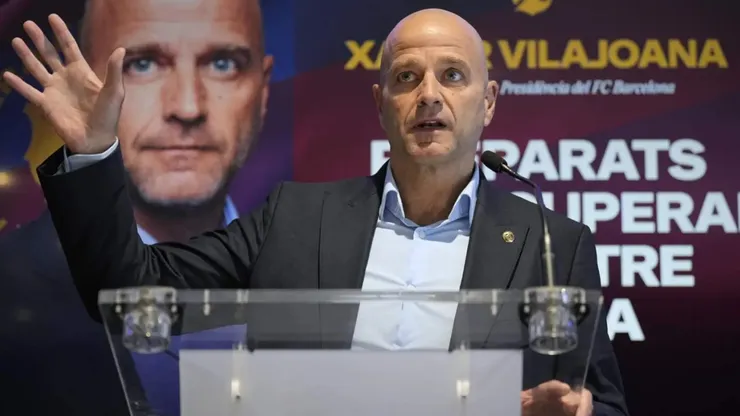
Unlike clubs such as Manchester City, PSG, and Manchester United, FC Barcelona operate under a rather particular management model. As they are owned by their 141,390 members, they have the power to elect the president who will lead the club every six years. In 2021, Joan Laporta took the reins of the club, but he recently stepped down in pursuit of re-election. In this context, Xavier Vilajoana has taken on significant prominence as a presidential candidate.
Vilajoana has spent more than 20 years at Barcelona, first as part of the squad as a player and later serving as a board member under Joan Laporta, Sandro Rosell, and even Josep Maria Bartomeu. With his experience, Xavier is now positioning himself as a candidate for the presidency. At World Soccer Talk, he chose to grant us an exclusive interview, discussing key aspects of his electoral campaign, addressing Joan Laporta’s management, Lionel Messi, La Masia, and several other relevant topics.
Xavier Vilajoana has spent over 20 years at FC Barcelona
WST: Could you tell us more about your roles during the presidencies of Joan Laporta, Sandro Rosell, and Josep Maria Bartomeu?
Vilajoana: “During Laporta’s first term, I was responsible for futsal, with the goal of professionalizing the section. Since I had retired two years earlier as a futsal player and team captain, I took on that role. Then, in 2010, Sandro Rosell brought me back for the same purpose: to support the section. That was when the futsal team won its first two Champions League titles. In 2015, I became responsible for youth football, La Masia, and the women’s team.”

WST: Did any of that experience with previous presidents motivate you to become a candidate for the presidency of Barcelona?
Vilajoana: “I believe that in a club like Barça, having a joint vision and a transversal vision is very important. Knowing the club in all its areas and, in the end, completing a kind of life cycle. I think the best way to continue serving the club is as president. There are always aspects left to contribute. Also, the club is not made up of isolated departments, but rather communicating vessels: the economic side, the sporting side, and the social side. I believe this is the way to complement and contribute all the knowledge and experience.”
Vilajoana delivers bold take on Joan Laporta’s tenure
WST: How do you assess Joan Laporta’s management in recent years?
Vilajoana: “What this board (Laporta’s) has done in recent years is the following: they have not been able to apply the 1:1 rule since they took over, and they have accumulated losses of nearly €300 million while selling assets and bringing forward revenues worth €900 million. We are talking about a board that, in four years, would have lost €1 billion, which is the current value of the first-team squad.
That is not opinion, those are official club figures. We are talking about stagnant ordinary revenues, with virtually no innovation in revenue streams. Everything was bet, at the time, on the exploitation of the Camp Nou. Barcelona is much more than that, or at least it should be. This board has been incapable, over all these years, of rethinking the model.
Ordinary revenues are the same as pre-pandemic levels. And people should also be told that we went through a terrible pandemic that caused a drop in revenues of almost €400 million, which brutally affected all European clubs. The difference is that clubs in Europe, since they have shareholders, asked for capital increases. But that is part of Barça’s unique model, which belongs to its members.”
Barcelona’s ownership model is non-negotiable
WST: Do you believe Barcelona should move toward a hybrid ownership model, like Bayern Munich?
Vilajoana: “No, that is non-negotiable. I also believe that our club model and legal structure are not incompatible with efficiency and sustainability. A brand like Barça has the potential to compete at the level of clubs that are privately owned or state-owned. Without any doubt. In fact, we have done so throughout our history.
Only in recent years have we been unable to sign players as we wish and have been constrained. Therefore, I believe the legal debate should not exist. This is about efficient management, surrounding yourself with the best professionals, and thinking about serving the club. I don’t believe the model is the problem—actually, I know it is not.”
Lionel Messi’s departure and his potential comeback
WST: Do you believe there was a possibility of renewing Lionel Messi’s contract despite the club’s financial urgency?
Vilajoana: “Definitely, yes—Messi could have been renewed. The problem is that he was not renewed before June 30, 2021. From that point on, he became a new signing. That is a very important factor, because from there the 1+1 rule came into play in a different way. An attempt was made to renew him as a new signing. This was negligence on the part of the president (Joan Laporta) and the board of directors. Negligence.
Then, looking at the facts, the economic excuse was extremely cheap. Because if the solution to Barça’s problems was not renewing Leo Messi, where is that economic solution? Where has it been seen? We have just said that if they had not sold certain assets, they would have lost €1 billion. So where is it? Therefore, I sincerely believe it was a cheap excuse. This would have to be explained by the current president. It was not an economic reason.”
WST: We know that Lionel Messi’s return as a player is difficult due to his contract with Inter Miami until 2028, but do you have a plan for his return in another role?
Vilajoana: “Leo is Barça and Barça is Leo. I was lucky enough to coincide with him for five years, and I believe his image or name should not be used for electoral gain. That would be a major mistake. I know him very well. He is a mature and intelligent person.
He will come back when he wants, and with any president—except the current one, who has already shown that he does not want him, and that if he were to come back under him, it would be at night. That must be very clear. I am very clear about it because I know him.
He will come when he wants, where he feels comfortable, and where he can contribute the most to the club. It is a matter of talking it through. Obviously, you can set certain red lines. I already have an idea of what he likes, but it would be somewhat opportunistic, knowing him, to use that kind of information. I keep it to myself because I know that, in due time, it will happen.”
Vilajoana criticizes Joan Laporta’s management of La Masia
WST: How do you assess La Masia’s management since your departure?
Vilajoana: “It has gone downhill. And we are seeing it. If La Masia ends up being the solution to everything, I always say it should not be the solution, it should be the priority. Always look at home first, and if pieces are missing or players need to be complemented, then look outside. In recent years, investment in La Masia, in player development, has been cut by nearly 40%.
That shows what is really thought of it. I believe they are mistaken. They think talent sometimes develops on its own, that it evolves on its own, and that it doesn’t need close attention. That is not true. It’s not just about finding talent, but about training it and helping it grow so that, when the time comes for the first team, the player is ready. That is exactly what has happened in recent years. Nobody thought Cubarsí, Gavi, or Balde would be there just because they had talent. They were worked on, trained, and prepared for when this moment arrived.”
WST: How would you explain to fans that investment in La Masia dropped by 40%, yet talents like Pau Cubarsí, Gavi, Fermín López, and even Lamine Yamal emerged?
Vilajoana: “These players were found. In fact, they were found already prepared. I am delighted that they have established themselves and that the first-team coach has given them opportunities. I am delighted because, selfishly speaking, well-done work bears fruit. And the work done in the past is reflected now.
What happens is that the lack of work now will be noticed in the coming years. In the end, results come after sustained work. If that work stops, and right now La Masia is at risk, we will notice it later. Then we will pull our hair out. We have to be very careful and very responsible—and they have not been.”
Xavier Vilajoana’s key role in Lamine Yamal’s move to La Masia
WST: How was Lamine Yamal La Masia’s arrival process handled at a family, sporting, and personal level?
Vilajoana: “I have always said that I don’t like to take credit. Not because recognition isn’t nice—it is—but it’s not my goal. Whenever I have been at the club, it has been because the club called me, needed me, and thought I could contribute my knowledge and experience, and there I was. With Lamine, I like to emphasize the more personal and formative aspect—helping the person more than the player. Well-formed players are always better players.
I believe it is the club’s responsibility not only to help players grow and protect them sportingly, but also personally and familially. At the time, Lamine was going through a complicated situation, as his parents were separating, which affects any child. We decided to break internal club rules and convince his parents to let him stay overnight at La Masia, to give him structure and closer personal follow-up because we believed he needed it as a child. In the end, time has proven us right.”
WST: We also witnessed the departure of Ilaix Moriba. Why did he leave the club?
Vilajoana: “With Ilaix, it is something I include in my program: At those ages, players sare still children. Then there are agents and agreements that parents reach with agents. That famous ‘environment,’ which is difficult to manage because, in many cases—especially with agents—the priority is not the player but the economic aspect, since they make a living from it. I don’t believe that helps the player.
We encountered that problem quite often. In the end, it was the player’s decision, conditioned or not, and he ultimately signed for RB Leipzig. The positive thing is that La Masia is a great academy that must continue producing talent, and it does. Therefore, we don’t need to tear our clothes over a player leaving or staying.”
La Masia as a cornerstone on Vilajoana’s project
WST: Are decisions to renew La Masia players made by the coach or by the board? We saw the departures of Nico González and Marc Cucurella.
Vilajoana: “It is neither one nor the other on their own. The club has the ability to set a line and a strategy. Mine has always been—and will always be—that the priority is homegrown players.
Two or three players per position are made available to the first-team coach, and it is discussed with him. But it cannot be that he dismisses 100% of the players presented to him. There must always be an initial trial under the coach.
On paper, it is difficult to measure whether a player will perform at the first-team level, because other factors come into play, such as pressure and how it is handled. All of them have potential, but performance is only shown by testing it.”
WST: We have seen world-class players like Lionel Messi, Iniesta, Xavi, Pedrito González, Busquets, Gavi, Balde, Lamine, and others, La Masia has always struggled to produce forwards. Why?
Vilajoana: “Because it is one of the most complicated positions in our style of play. Think about the profile required: a player who can combine, create space, play in tight areas—because in positional football at Barça you usually pin teams back—and also score goals.
Writing the letter to the Three Wise Men is easy, but getting all the gifts you ask for is difficult. These things have to be worked on, but it is not easy, because goals cannot be trained too much. That famous goal instinct—you either have it or you don’t. Everything else can be worked on.”
Harry Kane’s potential arrival
WST: Do you think there is still a possibility of signing Harry Kane? Because according to Max Eberl, Bayern Munich’s sporting director, his release clause has already expired.
Vilajoana: “This ultimately has to be discussed, because it depends on the player’s willingness. When I mentioned Harry Kane, it was because we are looking at different profiles, and we believe he is a very interesting profile for Barcelona.
From there, there have been approaches. We agree on the type of player that fits us, but there are others, in different positions, that we believe need strengthening after looking at the players coming through La Masia and analyzing the potential market.”
Hansi Flick’s future may rest in his own hands
WST: Do you consider Hansi Flick to be the ideal coach for Barcelona? Would you seek continuity or opt for another profile?
Vilajoana: “He has a contract (which expires in June 2027) and he is doing well. It is not easy to get performances out of such young players. What is true is that Hansi needs reinforcement from the club, and he has not been given it. When in January you need to sign players and, with all due respect, the reinforcement is João Cancelo—I do not doubt his quality—but I believe there should have been much stronger options.
I think what works must be reinforced, and what doesn’t work must be changed. In this case, Hansi has understood the club’s philosophy, is getting good performances, but I believe he needs support because there is room for improvement.”
200+ Channels & Local Sports
- Price: Plans starting at $14.99/mo (Latino)
- Watch Ligue 1, Copa Libertadores & World Cup Qualifiers
Every MLS Match in One Place
- Price: $12.99/mo (Now included with standard subscription)
- Watch every MLS regular season game, Playoffs & Leagues Cup
Many Sports & ESPN Originals
- Price: $11.99/mo (or ESPN Unlimited for $29.99/mo)
- Features LaLiga, FA Cup & NWSL
2,000+ Soccer Games Per Year
- Price: Starting at $8.99/mo
- Features Champions League, Serie A & Europa League
Home of the Premier League
- Price: Starting at $10.99/mo
- 175+ Exclusive EPL matches per season