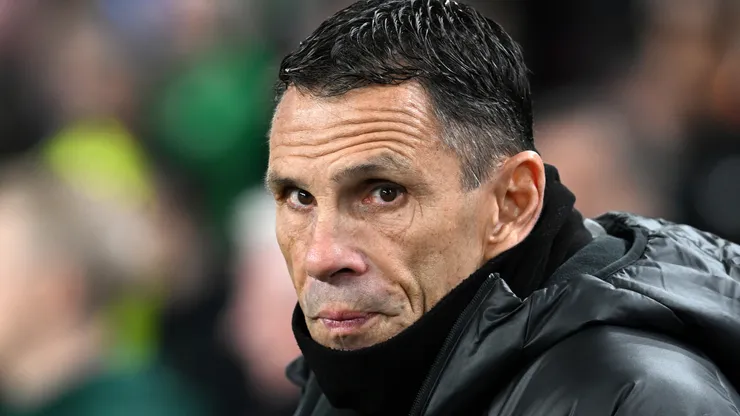
He may have been born into basketball patrimony, but Gustavo Augusto Poyet Domínguez has made his name in football. The son of Washington Poyet, who played basketball for Uruguay in the 1960 and 1964 Summer Olympics, and the brother of Marcelo, who played the sport professionally in South America, Gustavo was enamored with football from the start.
Born on November 15, 1967, Poyet started off at the academy of Club Atlético River Plate before heading across the Atlantic and joining Ligue 2 outfit Grenoble Foot 38 in 1988. Poyet scored eight goals in 39 appearances before returning to his hometown of Montevideo and plying his trade with River Plate, only to head back to Europe after a few months and join LaLiga outfit Real Zaragoza in 1990.
“When you are young in Uruguay, playing football, there are two main objectives. One is to play for one of the two biggest teams in Uruguay, and if you cannot, to go abroad, because obviously, the career of a football player is very short. In Uruguay, it’s one thing to be a professional footballer, and it’s another thing to earn good money,” stated Poyet in an exclusive World Soccer Talk interview.
“As I wasn’t playing for Peñarol or Nacional, I received the opportunity to go to France. My idea was to go to Nice in the first division, who had two foreigners from Yugoslavia—one was supposed to leave but ended up staying—and in the last few days of the window, Grenoble appeared with a bigger offer for me and for my club, River Plate. Having been in France for three weeks already, I loved the way that their professional football looked, and I signed for Grenoble, which, in terms of personal experience, was fantastic. But I didn’t play well, I didn’t perform, and I didn’t adapt to that particular team at that moment in time in my career. I was very young, I spent too much time alone, and it was very difficult for me, but I grew up as a person.”
Poyet emerged as an indispensable figure for Zaragoza, leading them to safety before spurring them to back-to-back Copa del Rey Finals, winning the second vs. Celta de Vigo, before engineering famous wins against Feyenoord, Chelsea, and Arsenal en route to the UEFA Cup Winners’ Cup title, their first European trophy in 31 years. Similarly to other players like Jesper Karlström, Poyet’s mix of industrious work-rate and goal-scoring instincts made him a crucial figure in midfield.
And just a few weeks after becoming a European champion, Poyet became a South American champion after leading Uruguay to the 1995 Copa América on home soil. All things considered, Poyet scored three goals in 21 appearances for Uruguay between 1993 and 2000. He then called it quits on his time in Spain after 74 goals and two assists in 276 appearances, departing as Zaragoza’s longest-serving foreign player, and making the move to Chelsea in 1997.
After his stellar start was interrupted by an ACL injury, Poyet returned to form and led the Blues to glory in the UEFA Cup Winners’ Cup and FA Cup, before being pushed out by new manager Claudio Ranieri. He then moved to Tottenham Hotspur in May 2001 for £2.2 million, spending three years in North London before hanging up his boots and stepping into management.
After following ex-Chelsea teammate Dennis Wise from Swindon Town to Leeds United, Poyet returned to Tottenham as an assistant coach to Juande Ramos. Six years after losing the League Cup Final in Cardiff as a Tottenham player, Poyet helped Spurs prevail 2-1 in extra time against Chelsea at Wembley. But deep down, he always knew that he wanted to branch out from assistant management and try his luck in coaching. It’s why he decided to make the move to Brighton & Hove Albion, leading them to promotion to the EFL Championship and setting the foundations for their golden era over the past decade.
“I think, apart from one or two difficult times with coaches, the idea of Brighton chairman Tony Bloom, from the moment I left, was to bring coaches who will play a similar style. After me, it was Óscar García, Roberto De Zerbi, and Graham Potter, who was playing such a nice kind of football at Swansea City, and Fabian Hürzeler is now a tremendous coach. The idea behind bringing certain coaches was always based on what we created as an identity.
“It took us a while to change the mentality of the fans, because they wanted long-ball English play, but then we started… there is a moment in my career at Brighton which is fundamental, and it’s two games away from home in my second season, in League One. It’s away at Peterborough, and away at Charlton; we’re playing them off the park, and the fans started singing and embracing the style. It was like, ‘This is Brighton, you know?’ After that, they knew they would be that style forever, and I think now it would be very difficult for Brighton to play a different way. That doesn’t mean that we are the same; we are not the same. All the coaches, we are different. But the idea of expecting the ball, playing from the back, keeping possession, trying to be creative, always playing offensive football, that started with me in 2009/10.”
After a four-year magnum opus at the Amex, Poyet then became the first Uruguayan to coach in the Premier League after taking charge of Sunderland in October 2013. Poyet quickly made an impression by leading them to the EFL Cup Final and steering them to a last-gasp escape from relegation, only to be sacked in March 2015.
He then departed England for a Mediterranean tour featuring Greek side AEK Athens and Spanish outfit Real Betis, before trying his luck in Asia for the first time ever. After a brief sojourn with Chinese side Shanghai Shenhua, Poyet took charge of French side Girondins de Bordeaux and developed future stars like Aurélien Tchouaméni and Jules Koundé before making the move to Chilean side Universidad Católica.
Poyet then transitioned into international management and became the manager of the Greek national team, taking four wins from his first four fixtures in League C of the 2022 UEFA Nations League and helping Greece earn promotion to League B, but he was unable to steer them to Euro 2024 after losing to Georgia on penalties in the final qualifier.
He spent nine months out of work before taking the reins at Jeonbuk Hyundai Motors and leading them to the two biggest trophies in South Korea—the K League 1 and the Korea Cup—before departing after a year. He’s spent the past four months in the upscale London neighborhood of Battersea, and whilst he’s enjoyed his time off, he’s more than ready to dive back into management.
“I’ve been taking advantage of my time off to do many different things. The first month, I came back to Uruguay in December after winning the Cup and spent time with my mom and my granddaughter, and then I came back to England and I started watching football and talking to people around football. I started a master’s online class on data and intelligence in football and in sports. Why? Because I want to be prepared, just in case. The future is all about numbers: I use the data, but I’m not crazy about the data. I use it to confirm things. I’m still thinking that football is much simpler than a number, but I want to have the information.
“I went to see a few training sessions of Getafe and Atlético Madrid thanks to coaches like José Bordalás and Diego Simeone, who allowed me to watch. I went to see a Real Madrid match live, I saw Tottenham-Arsenal live, I’ve been doing a little bit of press and podcasts, and I’ve been watching a lot of football. I’ve already received one offer and will probably receive another in the next week or so: I’m making decisions, and I’m ready to come back as soon as possible.”
200+ Channels & Local Sports
- Price: Plans starting at $14.99/mo (Latino)
- Watch Ligue 1, Copa Libertadores & World Cup Qualifiers
Every MLS Match in One Place
- Price: $12.99/mo (Now included with standard subscription)
- Watch every MLS regular season game, Playoffs & Leagues Cup
Many Sports & ESPN Originals
- Price: $11.99/mo (or ESPN Unlimited for $29.99/mo)
- Features LaLiga, FA Cup & NWSL
2,000+ Soccer Games Per Year
- Price: Starting at $8.99/mo
- Features Champions League, Serie A & Europa League
Home of the Premier League
- Price: Starting at $10.99/mo
- 175+ Exclusive EPL matches per season