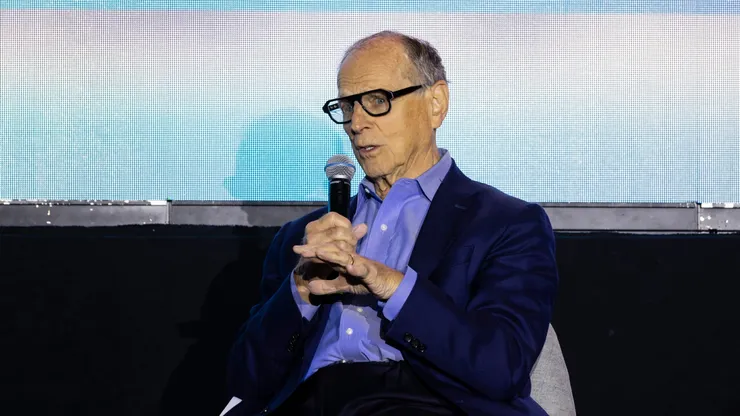
The United States has come a long way in the evolution of soccer since hosting the 1994 World Cup. More than three decades later, with Major League Soccer still growing. now led by Lionel Messi as its global face, and a competitive U.S. Men’s National Team, the World Cup will return to the U.S. in 2026 alongside Mexico and Canada.
That growth did not happen overnight, and the 1994 edition now feels worlds apart from what lies ahead in 2026. Considerable groundwork was required to reach this point. In an exclusive interview with World Soccer Talk, MLS co-founder and former U.S. Soccer President Alan Rothenberg reflected on the contrast between the two eras.
“If we go back to what we did in 94, everybody was concerned that this great experiment by FIFA might not have legs because the US obviously wasn’t considered a soccer country, so we determined that Americans love a big event,” Rothenberg, one of the architects of that tournament, said. “And so while soccer would be at the core of it, we were going to just surround it with celebrities and entertainment and all kinds of things to get public attention, and make people believe this is a big event we can’t miss it and therefore we’ll buy tickets and come and we’ll watch what we had on television.
“That really set the tone because up until then the World Cup basically was presented as a soccer tournament as it is, and of course it was in soccer loving countries and so you didn’t have to, you know, create a hype around it because it was built in. And so in that way we set the tone and, of course, in 2026 they are expanding upon what we created in 1994.“

The evolution of soccer in the United States since the 1990s
Compared to other nations, the U.S. struggled for decades to establish a stable domestic league, cycling through failed ventures such as the American Soccer League and the original NASL. Since its founding in 1996, however, Major League Soccer has emerged as the flagship of U.S. soccer, achieving steady, sustainable growth and global recognition.
Rothenberg reflected on that evolution: “I cover a lot of what you just talked about and then some in the book I just finished writing. It’s going to be out in early February. It’s called the ‘The Big Bounce, the Surge that Shaped the Future of U.S. Soccer‘ and it really goes into things even further back, but it starts in 1990 and the events that occurred, with everything building on what came before.“
Rothenberg also played a pivotal role in the 1984 Los Angeles Olympics as soccer commissioner, a major turning point for the sport domestically. He highlighted the importance of the U.S. women’s national team winning the inaugural Women’s World Cup in 1991, while also outlining the careful steps taken ahead of the 1994 men’s tournament.
“We did a test case in the summer of 1993 where we invited England, Brazil and Germany and had a round-robin tournament. It was really just to make sure to logistically we could handle a tournament, and we did. We beat England, shocked everybody and played credibly against Brazil and Germany. Although they both defeated us, and that was important because no matter how we hype the tournament, if our team fell flat on its face, the future probably would not have been as rosy as it’s become.“

As with 2026, the 1994 World Cup draw was designed as a spectacle rather than a technical exercise. Rothenberg wanted to “make it huge.” “The night before we had a big gala and we had James Brown and Smokey Robinson were the performers, Stevie Wonder too, and then the day of the draw we had all kinds of celebrities present like Robin Williams, and seeded and was unbelievable to the point where he still gets YouTube viewers because it was such a classic performance and at the same time.“
“We still have the record for average attendance. It’ll be broken in 2026. We still have the record for the amount of the surplus and that probably will stand. So from that standpoint there was a lasting effect where we launched Major League Soccer based on the results of 94. We had that surplus and with that we created the US Soccer Foundation, which still exists today and is will be in perpetuity in helping support.“
Following 1994, Rothenberg also pushed for women’s soccer at the 1996 Olympics and helped secure hosting rights for the 1999 Women’s World Cup. “One thing built off of the other and it’s been straight uphill ever since. 30 years later, MLS has got 30 teams continuing to grow and NWSL, the Women’s League, after some rocky starts, they’re on a great trajectory, and the USL has teams virtually everywhere in America, and again well established; so ‘one thing built on the other’ is going to continue.“
MLS: a success after 30 years
MLS celebrated its 30th anniversary season in 2025, marking remarkable growth from its original 10 teams to 30 today. “It surpassed whatever we thought. I mean, it isn’t like we set goals that by, you know, year five, it’ll be a this, year 10, it’ll be at this stage,” Rothenberg admitted, with the objective to create a single entity instead of leaving clubs to operate independently.
“And then the MLS under Don Garber’s leadership and the owner group has been clever enough to create some exceptions to the single entity, if you will.
And allow for example, some special deal to bring (David) Beckham in and then more recently to bring Messi in exceeding our normal salary caps which were established through the single entity.“
Beyond Messi, Rothenberg highlighted Son Heung-min’s arrival as equally significant: “I mentioned Messi, but I think in some ways the more dramatic signing recently like Son because he’s not in his late 30s, he’s just 30 (33). So he’s still in the prime of his career and I think that’s going to be key and I think that’s going to be one of the things that comes out in 2026, that there’ll be the a boost in the economic support for MLS teams and they can use that then to bring in more top world world class players from Europe.“
Messi and his impact compared to other stars
Stars like Thierry Henry, David Villa, Andrea Pirlo, and Zlatan Ibrahimović all left their mark on MLS, but none matched Messi’s impact: “The first time around, when he played, it was a sellout. Obviously, as he returned and now he’s played for three years, it’s not a novelty anymore. But if you love sport, if you love soccer, you love seeing his magic, which continues.“
Rothenberg emphasized a key difference between Messi and many past signings: “The other thing too it’s pretty clear, and it’s that they aren’t treating it as, you know, a paid retirement. They’re really getting into it, supporting the team, going out and making public appearances and they’re talking up the game. And so that’s really crucial because in many cases. The other players that have come in, it’s a nice way to finish their career, but they were not committed, if you will, to building the sport in America.
“Beckham is obviously because he’s behind the ownership of Inter Miami and probably key to bringing Messi over, then Messi, and as I said, he just got here, so it’s harder to tell, but based on his initial coming to the LAFC team, Son looks like he’s comparably one that is really here to play, enjoy, be part of the team and be part of the growth of the league, which is great.”
Rothenberg even hinted at Messi’s international future: “The one competition that he had not won up until now was the Major League Soccer and of course he just led Inter Miami to the win the MLS Cup. So his plate has been finally full. And obviously everybody’s looking forward to a last hurrah, if you will, in 26. I mean, he previously said he’s not going to play for the national team again, but I can’t believe he’ll stick to that.“
Messi and the MLS salary cap
One of the central talking points of the 2025 season has been the MLS salary cap, which drew criticism from several Inter Miami players, including Lionel Messi, over the club’s ability to build a competitive squad. Asked about the league’s current limitations, Alan Rothenberg did not shy away from the topic, instead praising the work of MLS leadership.
“Don Garber and his owners have done an excellent job of doing what they have to do in order to take things to the next step and also to seize potential opportunities when they appear. So I have no doubt that they will continue to do that. Maybe they’re going to add a fourth DP, and obviously as far as the salary cap is concerned, that goes up every year, and obviously some of that gets negotiated with the Players Association, so it will be more and more financially remunerative to players and to owners.
“I think for the path forward, there’ll be hurdles obviously, but I think we’ll do well. The change to get on to the international calendar also will benefit MLS because they’ll have the equal opportunity in the player transfer area to the sign or sell players. Now, you know, they just have that brief window in the middle of the season, and it makes it disruptive. Obviously, if you’re bringing in a player at midseason, we’d love to have him all year, so that move to the international calendar will be very beneficial also.”

Cristiano Ronaldo, Saudi Pro League, and star-driven growth
Prior to Messi’s arrival in MLS, Cristiano Ronaldo completed his move to Al Nassr in 2022, becoming the face of Saudi Arabian soccer and kickstarting an aggressive push to sign European stars. Compared to MLS’ strategy, however, the Saudi Pro League has fallen short of securing the same level of global broadcast deals, underscoring that attracting star players alone is not enough to guarantee success.
Asked about the strategy of bringing stars as a core, Rothenberg was clear: “Well, ultimately everything depends on performance of the teams and the star power helps to win. It’s the right player, but equally important, it draws attention beyond just the people that are in the stadium. And I’m now talking about people that are going to watch matches on television and the goal that every pro league and everywhere really depends on is media money.
Rothenberg expects the 2026 World Cup to be transformative. “Whatever the platform is, the key is TV money, and that’s the one place where MLS is languished and I’m expecting that 2026 will change that dramatically,” he stated.
“Again, more people, more eyeballs, watching matches and therefore more money coming from various media platforms, and then it becomes certain, because with that more money then the MLS teams can bring more star players in which hopefully creates even more interest, which then in turn creates more media revenue. It won’t be that in 2027 immediately everything just explodes. It’ll be gradual, rapidly gradual, continued growth,” he concluded.
USMNT and expectations for 2026
The U.S. Men’s National Team has generated growing expectations among fans in recent months. Alan Rothenberg noted that beyond the advantage of hosting and the group-stage opponents revealed in the draw, recent performances against top nations, even without European-based stars such as Christian Pulisic, have fueled optimism about how far the team could go.
“I think there’s a lot more enthusiasm and bordering now on a little bit of optimism as we go in. You know, it’s hard to say that we’re lucky with the draw, but it could have been worse, and two of the teams that are in there, we’ve already beaten just in this last round where we finally started to show some talent on the field,” Rothenberg added, as Paraguay and Australia are the confirmed rivals, previously defeated by Mauricio Pochettino’s team.
Still, he highlighted a longstanding issue compared to other big nations: “I mean, the biggest problem with the US perennially is what I said: It’s all scattered. When you look at who’s been the most successful in World Cups, Spain obviously now is dominant. Well, most of their players played in Barcelona and Real Madrid. They know each other either as teammates or as opponents. So it is a consistent style of play. Before that, the Germans dominated, and what? 10 out of 11 starters were from Bayern Munich, so they were truly a team. France is unique because, but they have that Claire Fontaine national training site and so every player comes through that.
“So there is a French style of play, if you will, and unfortunately, the United States up until now hasn’t had that because you got players scattered everywhere. I think a lot of that’s going to change. I think we’re going to end up having a Claire Fontaine type model because we now have just the generosity of Arthur Blank who created a new headquarters training site in Atlanta, and I think from now on we’ll have our players going through that same way as the French have their players going to Claire Fontaine, so I’m optimistic about that.“
Back at the 1994 World Cup, the U.S. Men’s National Team was drawn into a group with Colombia, Switzerland, and Romania. Against expectations, the Americans upset Colombia and fell to Romania, flipping most pre-tournament predictions. Still, the team made a strong impression by advancing to the knockout stage, even if the results did not unfold exactly as anticipated.
“I don’t think we dare get up over optimistic because, two of the teams that we’ve drawn into our group are teams we recently beat. So we can’t be overly optimistic, but at least cautiously optimistic I guess is what I’d say. And then obviously once you get into the knockout phase, everything changes. A lot of it depends on who who we first play.
“And again in 94, good and bad news: The bad news, if you will, is who do we draw (Brazil). But it turns out actually it was the good news because we played them competitively. So that put us on the competitive match and people finally were going to give us a little bit of respect and say we actually belong in the tournament, not just because we’re the host, but also it electrified our fans,” Rothenberg highlighted, before explaining the excitement and how fans showed their support.
“It was on our independent stage, July 4th. And our fans looked like the Brazilian fans. They were all painted, flag waving, singing. And so it was like the first time, as far as I could tell, that that they really caught the fever, that they really got the unique spirit of the World Cup, and so on one hand, it was a shame we drew Brazil because hopefully we would have beaten somebody else. But the good news is, as I said, we established our credibility on the pitch and the fans established themselves as being a true soccer fan.”
Over the past several months, Mauricio Pochettino has begun shaping a competitive squad after calling in more than 40 players throughout 2025. With the World Cup approaching, even Rothenberg, a central figure in U.S. soccer and the 1994 tournament, believes the 2026 edition is poised to reach new heights, not just for the USMNT, but for the sport in the United States as a whole.
200+ Channels & Local Sports
- Price: Plans starting at $14.99/mo (Latino)
- Watch Ligue 1, Copa Libertadores & World Cup Qualifiers
Every MLS Match in One Place
- Price: $12.99/mo (Now included with standard subscription)
- Watch every MLS regular season game, Playoffs & Leagues Cup
Many Sports & ESPN Originals
- Price: $11.99/mo (or ESPN Unlimited for $29.99/mo)
- Features LaLiga, FA Cup & NWSL
2,000+ Soccer Games Per Year
- Price: Starting at $8.99/mo
- Features Champions League, Serie A & Europa League
Home of the Premier League
- Price: Starting at $10.99/mo
- 175+ Exclusive EPL matches per season