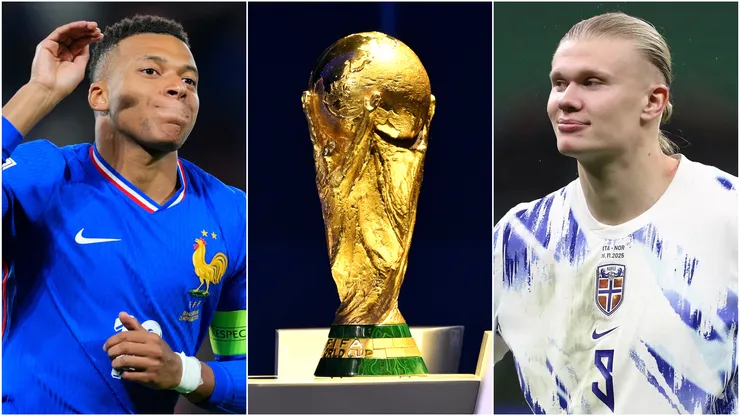
The expanded 2026 FIFA World Cup has delivered a landscape unlike anything the modern game has seen, and it begins with star-driven intrigue. The draw brings the prospect of Kylian Mbappe facing Erling Haaland and Harry Kane coming up against Luka Modric, early marquee duels that carry both celebrity weight and sporting significance. With 48 nations split across 12 groups, each country faces a uniquely shaped path—some walking into brutal gauntlets, others stepping into opportunity.
Yet the full truth of which groups are brutal, balanced, or forgiving reveals itself only once the entire draw is unpacked—and that unveiling reshapes expectations for every contender.
The 2026 tournament’s leap to 48 teams fundamentally alters the psychology of the group stage. With three teams progressing from each group, the margin for error is wider—but so too is the potential for chaos. Traditional favorites cannot simply coast; mid-tier nations now see a real knockout-round possibility, and dark horses lurking in loaded groups know that one upset could change everything.
The result is a field where strength is measured not just by star power, but by depth, momentum, and the inherent tension of a larger, more volatile format. Only once we dig into the composition of each group does the real drama emerge.

The 12 groups revealed and ranked
Below is the full ranking of 2026 World Cup groups—from the true “Groups of Death” to those offering a smoother ride into the knockout rounds.
1. Group L (England, Croatia, Ghana, Panama) – The true group of death
This group is loaded in every sense. Harry Kane’s England remains a global powerhouse with elite depth. Luka Modric’s Croatia, even in transition, remains one of the sport’s most consistently dominant tournament teams. Ghana returns with one of Africa’s most dynamic squads, capable of upsetting anyone. Panama, while the underdog, is far stronger than in 2018.
A brutal, high-quality, unforgiving group.
2. Group E (Germany, Curacao, Cote d’Ivoire, Ecuador) – Power vs. Dark horses
Germany is always dangerous, but this group’s real difficulty comes from the unpredictable strength of the challengers. Cote d’Ivoire and Ecuador are two of the most physically intense teams in world football, both capable of winning big games. Even Curacao—well-coached and technically sharp—can’t be ignored.
A sleeper group that guarantees drama.
3. Group G (Belgium, Egypt, Iran, New Zealand) – Tournament minefield
Belgium is no longer the Golden Generation, but still elite. Egypt, with years of continental pedigree, is tactically tough and disciplined. Iran consistently frustrates world-class opponents. Even New Zealand, the weakest on paper, is tactically structured and notoriously difficult to break down. A tactician’s nightmare.
4. Group F (Netherlands, Japan, Play-off B, Tunisia) – High tempo, high pressure
A very tricky group. The Netherlands is tactically sophisticated, Japan plays some of the world’s most organized football, and Tunisia brings tournament experience and defensive grit. The Play-off B winner (one of Albania, Poland, Sweden, or Ukraine) could make this group even tougher.
There are no easy matches here.
5. Group I (France, Senegal, Play-off 2, Norway) – Star power everywhere
On paper, France and Kylian Mbappe should dominate. But Senegal is Africa’s strongest all-around team, Norway arrives with Erling Haaland and Martin Odegaard, and the Play-off 2 winner could be Bolivia, Iraq, or Suriname. Top-heavy but extremely competitive behind France.
6. Group C (Brazil, Morocco, Haiti, Scotland) – Clash of styles
Brazil and Morocco alone make this challenging: South America’s giants vs. Africa’s most complete team. Scotland is aggressive and well-drilled, while Haiti can be unpredictable with attacking flair. One powerhouse, one elite challenger, two dangerous spoilers.
7. Group J (Argentina, Algeria, Austria, Jordan) – Champions with quiet threats
Lionel Messi’s Argentina, the reigning world champions, anchors a group with three very different tests. Algeria brings creativity and midfield quality; Austria has become a disciplined pressing team under Ralf Rangnick’s influence; Jordan is improving and tactically stubborn. Argentina should progress, but the battle for second is wide open.
8. Group H (Spain, Cabo Verde, Saudi Arabia, Uruguay) – Spain vs. South America’s wild card
Lamine Yamal’s Spain is the favorite, but Uruguay is always a tournament disruptor, especially with a new generation emerging. Saudi Arabia has proven capable of shocking giants; Cabo Verde is one of Africa’s rising forces. Not the toughest group—just an unpredictable one.
9. Group D (USA, Paraguay, Australia, Play-off C) – Balanced, but not brutal
On home soil, the USA and Christian Pulisic enter as favorites. Paraguay is inconsistent but dangerous, Australia is rugged and organized, and the Play-off C winner (Kosovo/Romania/Slovakia/Turkey) could add real bite. A tough group, but not the deepest talent-wise compared to the others above.
10. Group A (Mexico, South Africa, Korea Republic, Play-off D) – Mexico heavily favored
Mexico should lead, especially as a co-host. South Africa and Korea Republic give contrasting styles, and the Play-off D winner (Czech Republic/Denmark/Israel/Macedonia) could easily disrupt the balance. Difficult for seeding, but not a top-tier “hard group.”
11. Group K (Portugal, Play-off 1, Uzbekistan, Colombia) – Two giants, two outsiders
Portugal and Colombia should control this group. Uzbekistan is technically talented but inexperienced; Play-off 1 (Congo DR/Jamaica/New Caledonia) lacks an elite pedigree. Competitive at the top, soft at the bottom.
12. Group B (Canada, Play-off A, Qatar, Switzerland) – Softest group
Switzerland is the strongest team here, but not a global powerhouse. Canada is rising but inconsistent on the world stage. Qatar is rebuilding after 2022. The Play-off A winner (Bhutan/Taiwan/Northern Ireland/Wales) is unlikely to be a major threat. This group lacks a traditional giant and contains three teams with major question marks.
200+ Channels & Local Sports
- Price: Plans starting at $14.99/mo (Latino)
- Watch Ligue 1, Copa Libertadores & World Cup Qualifiers
Every MLS Match in One Place
- Price: $12.99/mo (Now included with standard subscription)
- Watch every MLS regular season game, Playoffs & Leagues Cup
Many Sports & ESPN Originals
- Price: $11.99/mo (or ESPN Unlimited for $29.99/mo)
- Features LaLiga, FA Cup & NWSL
2,000+ Soccer Games Per Year
- Price: Starting at $8.99/mo
- Features Champions League, Serie A & Europa League
Home of the Premier League
- Price: Starting at $10.99/mo
- 175+ Exclusive EPL matches per season